Jera Value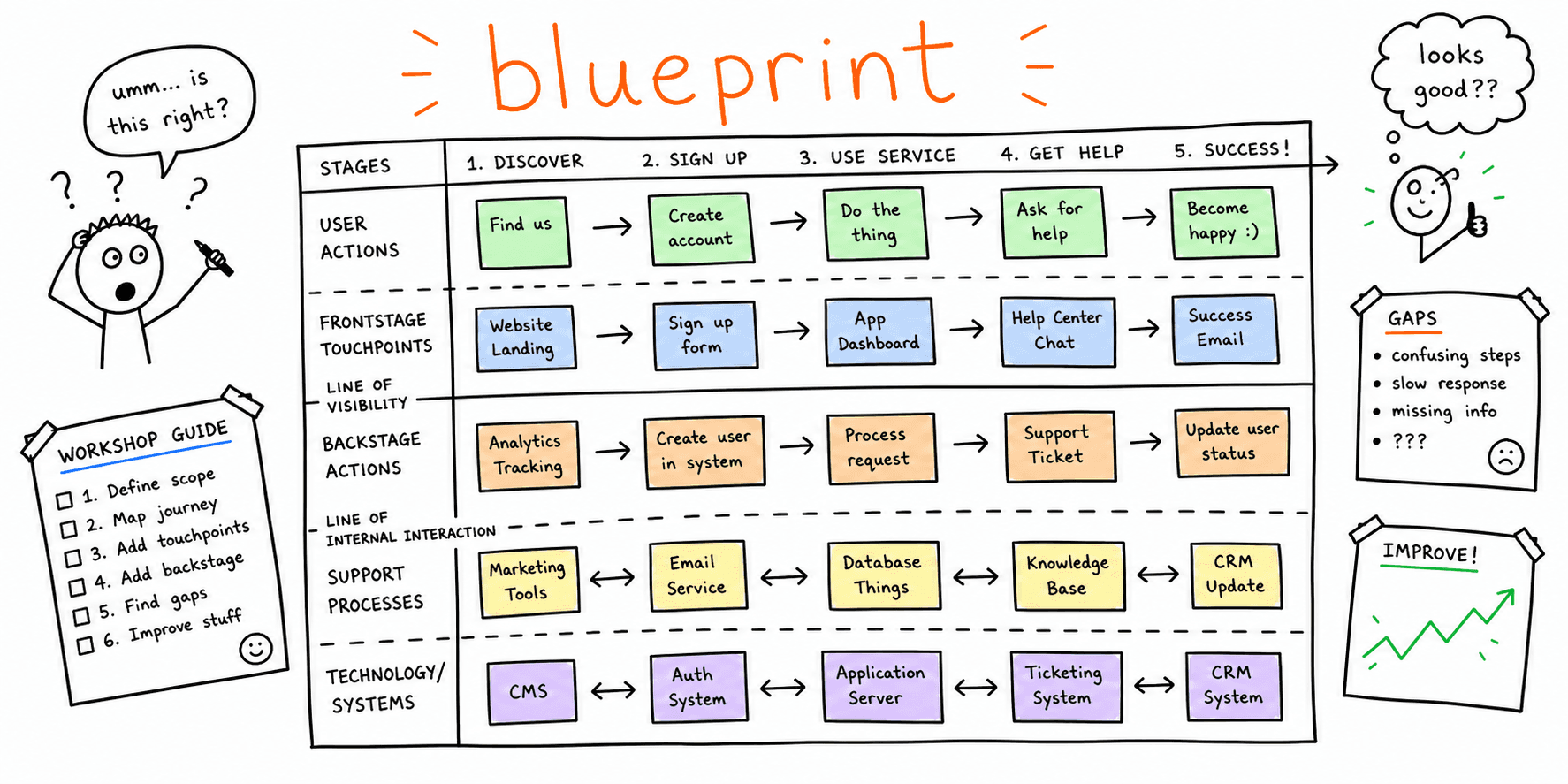

A service blueprint template helps teams map what users see and what the business must deliver behind the scenes.
Most teams document journeys but skip operations. That creates a gap between UX improvements and execution reality.
This guide gives you:
- a copy/paste service blueprint template
- a filled service blueprint example
- a practical facilitation workflow for cross-functional teams
- a scoring model to prioritize what to fix first
If you are already using our Customer Journey Map Template, this guide extends it into execution.
What Is a Service Blueprint?
A service blueprint is a process map that connects customer behavior to internal delivery.
A good blueprint includes:
- customer actions
- frontstage interactions (what customers can see)
- backstage actions (internal work customers cannot see)
- support systems and dependencies
- failure points and recovery paths
If your team currently works from only journey maps, this structure closes the gap between insight and implementation.
Service Blueprint vs Journey Map vs User Flow
These artifacts overlap, but they are not interchangeable.
| Artifact | Core question | Best use case |
|---|---|---|
| Service blueprint | "How do teams deliver this experience end to end?" | Operational design, ownership, handoffs, SLAs |
| Journey map | "How does this experience feel over time?" | Emotions, pain points, opportunity discovery |
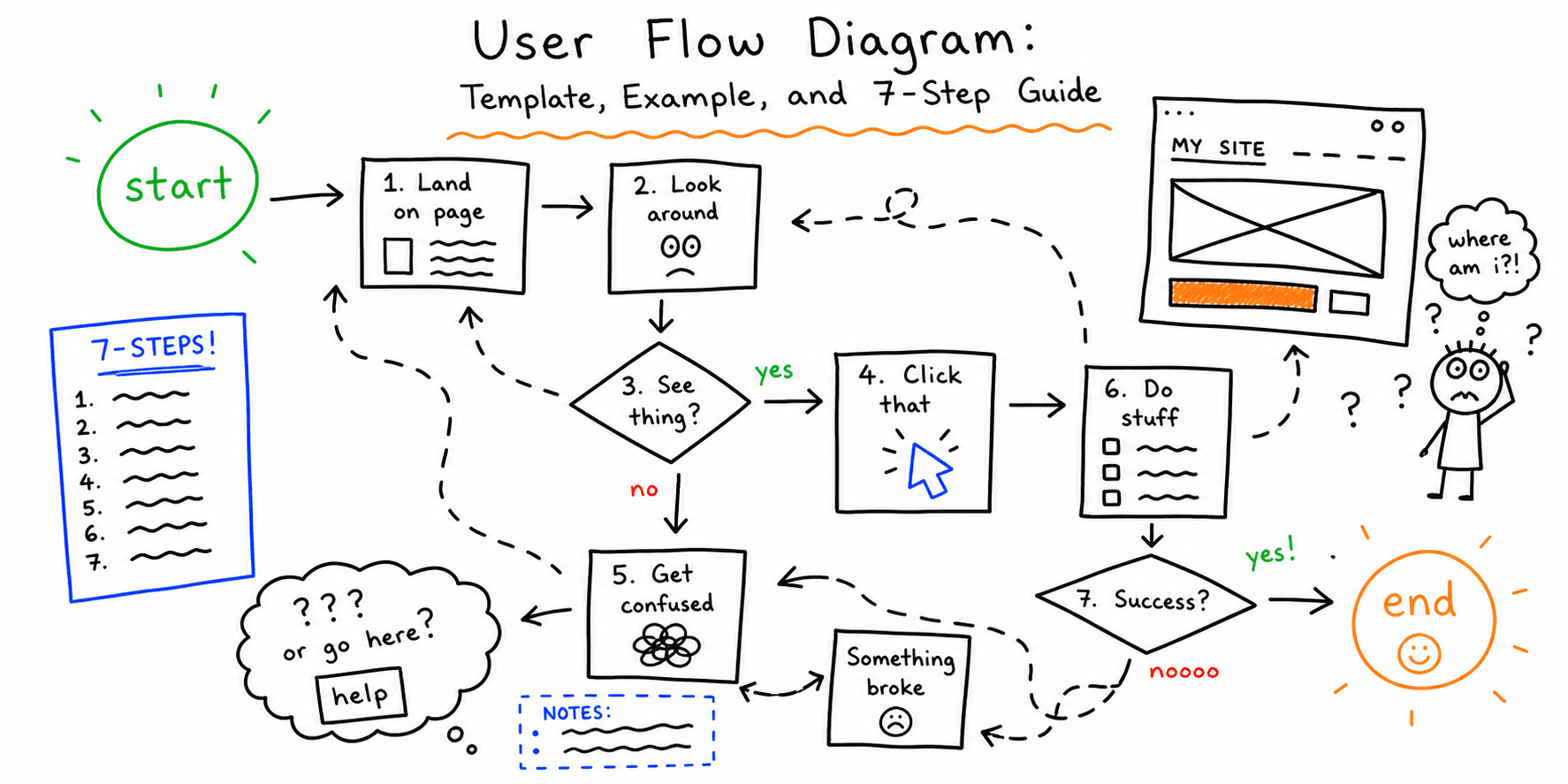
| User flow | "What steps does a user take in one task path?" | Navigation and task completion optimization |
Use this page when you need execution clarity.
Use User Flow Diagram when the problem is path friction.
Use Customer Journey Map Template when the problem is stage-level experience design.
When To Use a Service Blueprint Template
Use a service blueprint template when you need to:
- align product, design, engineering, support, and ops around one flow
- reduce handoff failures between teams
- expose hidden dependencies that cause delay or quality issues
- improve conversion and retention by fixing systemic delivery bottlenecks
Common scenarios:
- onboarding or activation redesign
- checkout or lead funnel reliability work
- support escalation reduction
- launch-readiness reviews before major releases
For launch and QA readiness, pair this with Website Launch Checklist and Website Quality Assurance Testing Checklist.
Service Blueprint Template (Copy/Paste)
Copy this table into a doc or spreadsheet before your workshop.
| Step | Customer action | Frontstage touchpoint | Frontstage owner | Backstage action | Support process/system | Evidence or artifact | Pain/risk | Metric | Priority (H/M/L) |
|---|---|---|---|---|---|---|---|---|---|
| 1 | |||||||||
| 2 | |||||||||
| 3 | |||||||||
| 4 | |||||||||
| 5 |
Use one row per interaction step. If multiple systems are involved, list all critical dependencies in the support column.
Layering model (recommended)
When your flow is complex, split the blueprint into layers:
- Customer actions
- Frontstage touchpoints
- Line of visibility
- Backstage workflows
- Platform/data dependencies
- Failure + recovery states
This keeps workshops clear and prevents missing invisible work.
How To Fill the Template in 8 Steps
- Define one scope and one success metric.
- List the customer steps in sequence.
- Add frontstage touchpoints for each step.
- Add backstage actions required to deliver each frontstage touchpoint.
- Add systems, tools, APIs, and manual dependencies.
- Mark failure points and likely user-visible symptoms.
- Assign owners per row and set service-level expectations.
- Prioritize rows with the score model below and move top items into delivery.
If your scope includes page-level conversion or UX quality, use Website UX Checklist, Website Usability Checklist, and Usability Testing Template to validate fixes.
Service Blueprint Example (SaaS Trial-to-Value)
Below is a compact service blueprint example for a SaaS onboarding flow.
Objective
Increase first-report completion within 24 hours.
Current state (sample rows)
| Step | Customer action | Frontstage touchpoint | Frontstage owner | Backstage action | Support process/system | Evidence | Pain/risk | Metric | Priority |
|---|---|---|---|---|---|---|---|---|---|
| 1 | Visits landing page | Hero + CTA | Marketing | Personalization rules loaded | CMS + experiment platform | Session recording | Message mismatch by segment | CTA CTR | M |
| 2 | Starts report flow | URL input form | Product | URL validation + queue job | Validator + job queue | Error logs | False validation failures | Start rate | H |
| 3 | Creates account | Signup form | Product | Account provisioning | Auth service | Funnel report | Drop-off at password step | Signup completion | H |
| 4 | Waits for report | Processing state | Product | Crawl + scoring + render | Crawler + scoring engine | Queue latency dashboard | Long wait with unclear status | Time to first report | H |
| 5 | Views first report | Results page | Product | Recommendation assembly | Rules engine + template system | Click maps | Recommendations too generic | Recommendation CTR | M |
High-impact changes
- Added pre-submit URL diagnostics and clearer error states.
- Added progress checkpoints during report generation.
- Added role-based recommendation summaries on first report view.
Expected outcome
- faster first value
- lower activation drop-off
- higher second-session return
If you need additional page-level diagnosis before redesigning this flow, run Website UX Audit, Website Content Analysis, and Landing Page Analyzer.
Prioritization Model for Blueprint Findings
Use a simple weighted model:
Priority score = (Impact x Frequency x Confidence) / Effort
- Impact: business and user effect if fixed (1-5)
- Frequency: how often the issue occurs (1-5)
- Confidence: evidence quality from data/research (1-5)
- Effort: delivery effort (1-5)
Sort by score, then assign owners and due dates.
You can align this with audit workflows from UX Audit Template and UI Audit Checklist.
Common Service Blueprint Mistakes
Mistake 1: Only mapping visible UX
Fix: Add backstage and system dependencies for every customer-visible step.
Mistake 2: No ownership per row
Fix: Assign one accountable owner per step, even when multiple teams contribute.
Mistake 3: No measurable outcome
Fix: Attach one metric to every high-priority row (completion, latency, error rate, CSAT).
Mistake 4: Treating blueprint as static documentation
Fix: Review monthly and after each major release cycle.
FAQ
Is this a free service blueprint template?
Yes. The copy/paste table above is free to reuse and customize.
Should I create one blueprint for each persona?
Start with one high-value persona and one critical service journey. Expand only after shipping improvements.
How detailed should a service blueprint map be?
Detail should match decision risk. If a step has high drop-off or operational complexity, add more detail there.
Can I use this for websites only?
No. The same structure works for product onboarding, support flows, and offline service operations.
References
- Nielsen Norman Group — Service Blueprints: Definition
- Nielsen Norman Group — How to Create a Service Blueprint
- Interaction Design Foundation — Service Blueprint
- Miro — Service Blueprint Guide
- Lucidchart — Service Blueprint
Related Resources
- Customer Journey Map Template
- User Flow Diagram
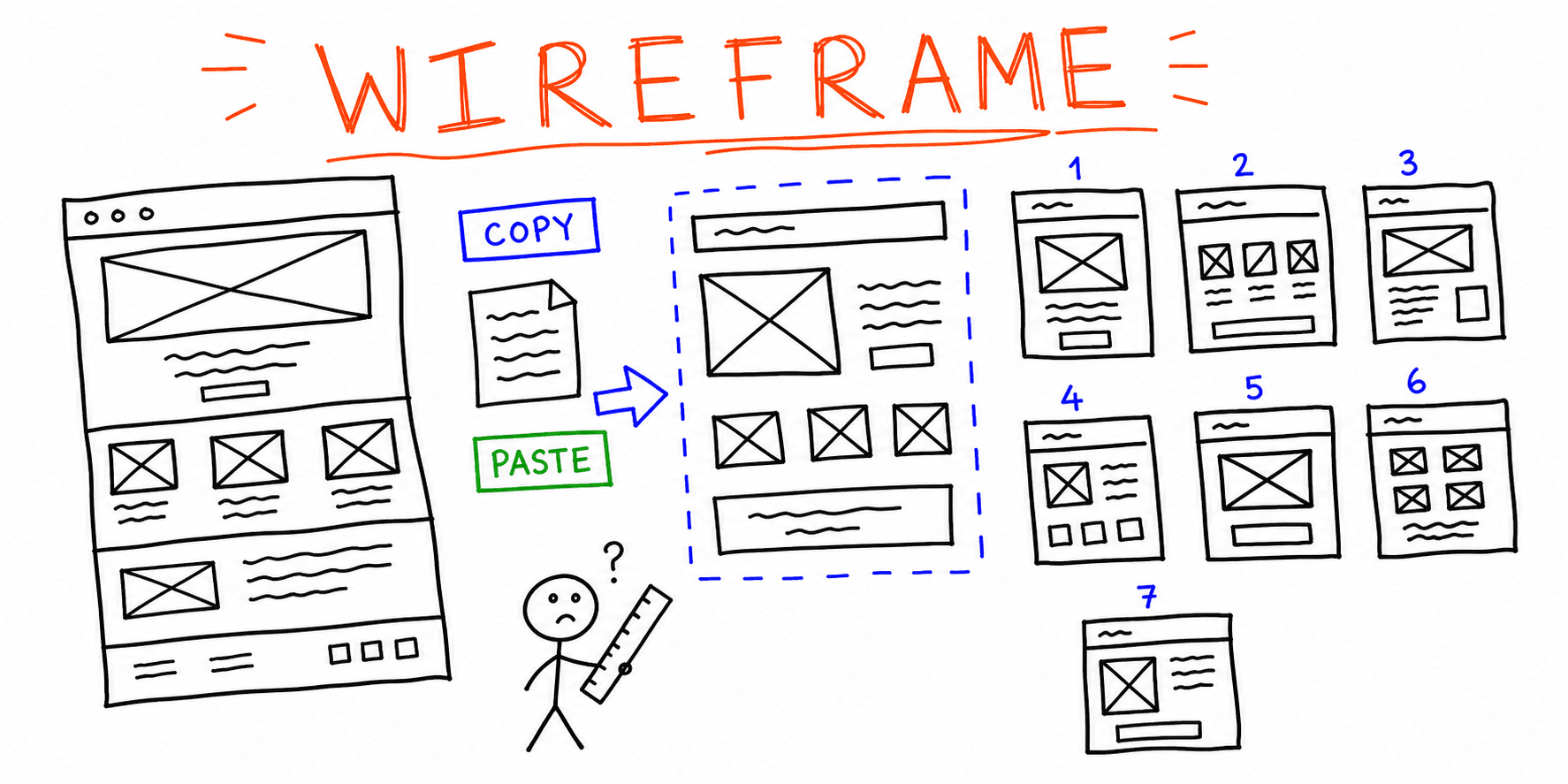
- Website Wireframe Template
- Usability Testing Template
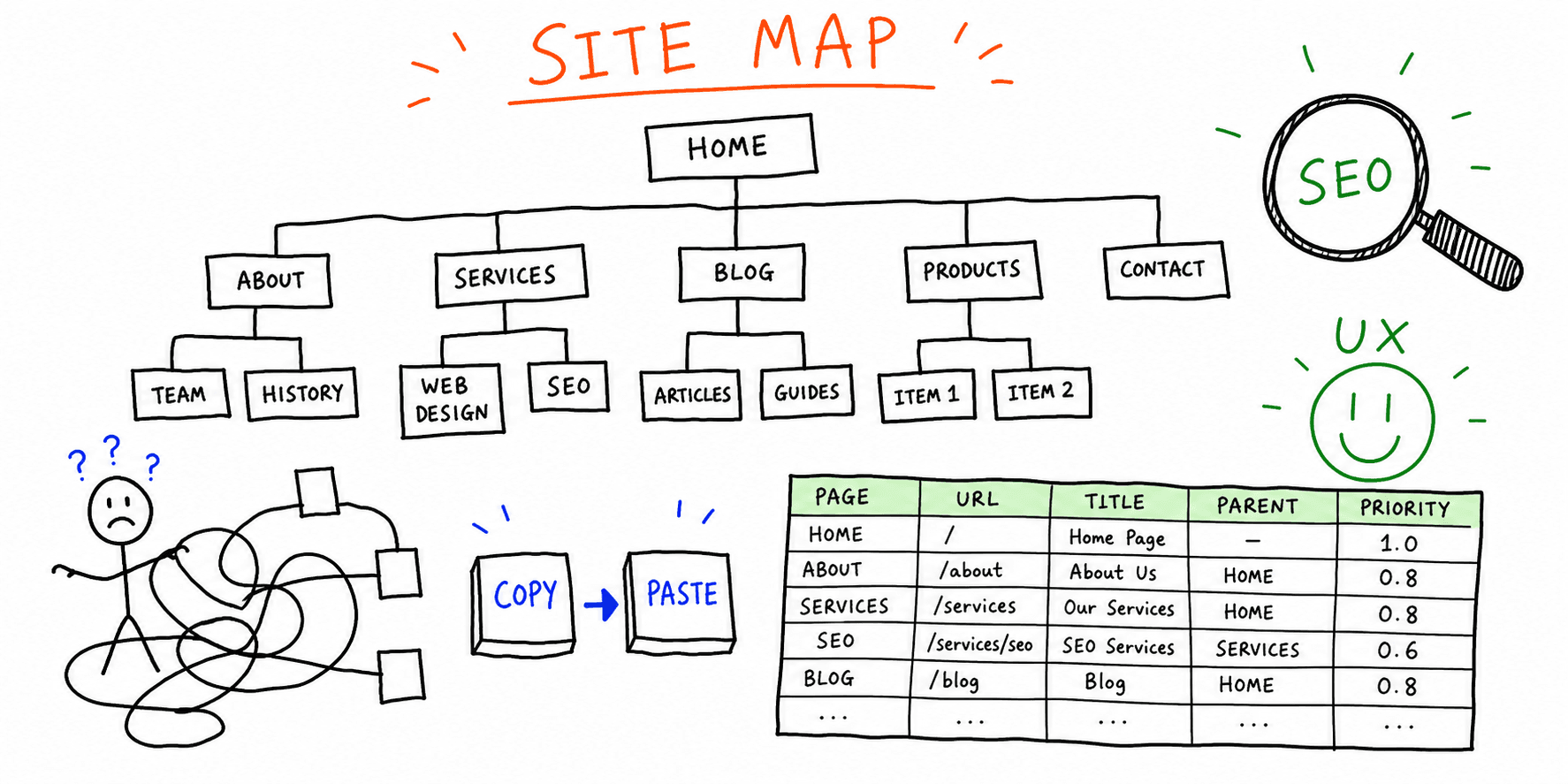
- Website Navigation Examples
- Website UX Checklist
If you want a fast page-level diagnosis before blueprinting, start with: Website UX Audit
For copy clarity and messaging issues that affect frontstage touchpoints: Website Content Analysis
For conversion-focused flow reviews on acquisition pages: Landing Page Analyzer