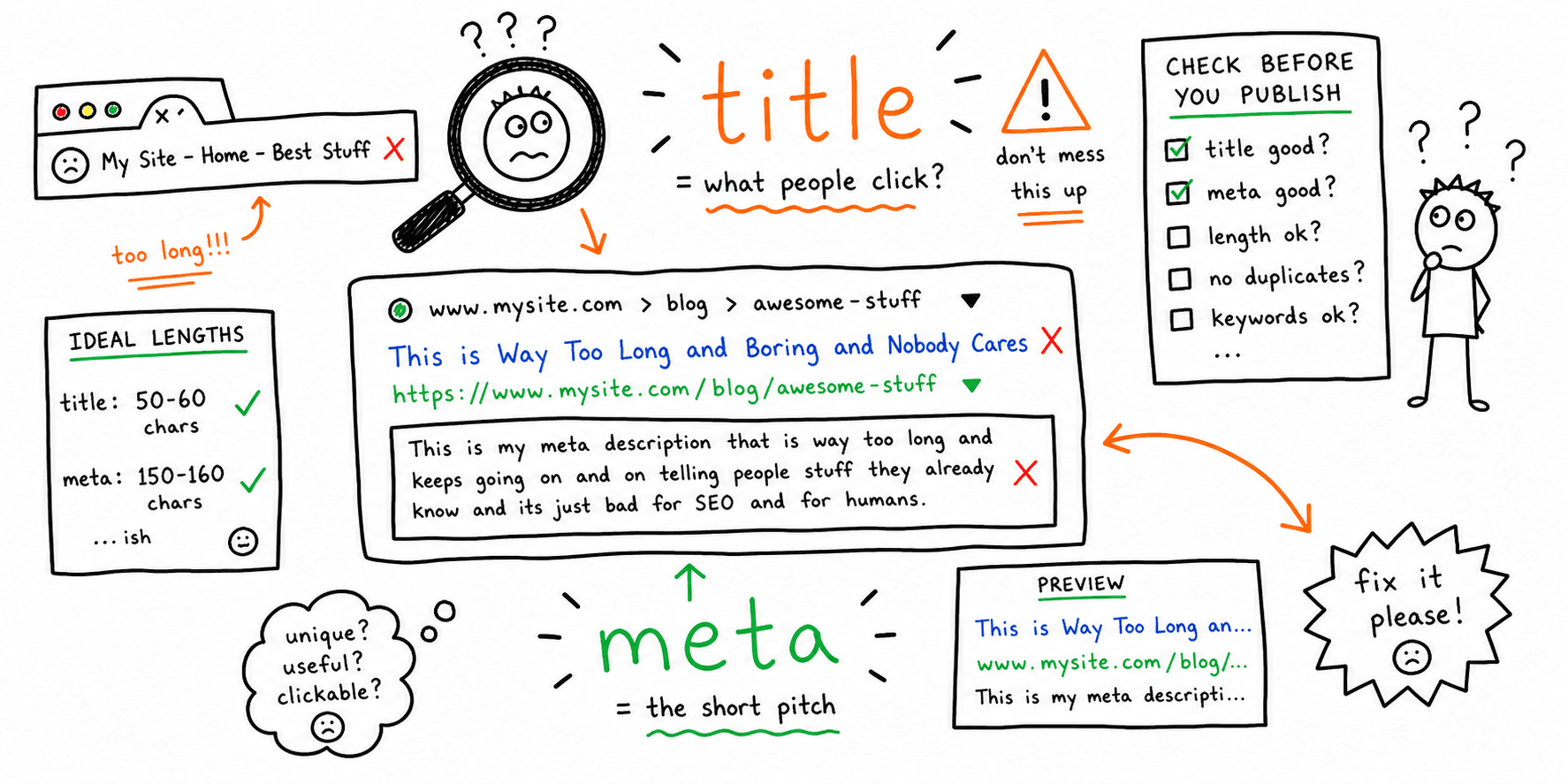

If you are looking for a title tag checker or meta description checker, the real goal is not just counting characters. The goal is validating whether your snippet is strong enough to earn the click and clean enough to avoid obvious SEO mistakes.
That means checking:
- length
- likely truncation
- keyword placement
- repetition
- brand usage
- whether the description adds a real click reason
If you want to generate ideas and then validate them in one workflow, use the SEO Title & Meta Description Tool. For page-level HTML review beyond snippets, use SEO Check HTML. For the broader technical context, keep the Technical SEO Audit guide open as well.
What a title tag checker should validate
A useful checker should answer four questions:
- Does the title fit typical SERP space?
- Does it place the primary keyword early enough?
- Does it overuse the keyword or brand?
- Does it match the page intent?
Practical title checks
| Check | Strong pattern | Warning sign |
|---|---|---|
| Length | Roughly 50-60 characters | Too short to communicate value or long enough to truncate badly |
| Keyword placement | Primary keyword appears early | Keyword appears late or not at all |
| Brand use | Brand appears once, usually at the end | Brand repeated or taking too much space |
| Readability | One clean idea | Too many separators, stuffed modifiers, or awkward phrasing |
What a meta description checker should validate
A strong meta description does not just summarize the page. It creates a reason to click.
Practical meta checks
| Check | Strong pattern | Warning sign |
|---|---|---|
| Length | Roughly 150-160 characters | Too short, too long, or obviously truncated |
| Message | Adds a benefit or next step | Just repeats the title in sentence form |
| CTA | Uses action language when appropriate | No click reason at all |
| Relevance | Matches the actual page content | Overpromises or sounds generic |
Character count is not enough
A lot of free tools stop at character counts. That is useful, but incomplete.
Two snippets can both be "160 characters" and still perform very differently:
- one may put the key value proposition first
- one may bury the benefit in the last clause
- one may be readable on desktop but truncate on mobile
- one may repeat the keyword so much it looks spammy
That is why a useful checker should combine length with a real preview and practical quality rules.
Title tag checker: common failures
1. Keyword too late
Bad:
A Complete Walkthrough for Teams Running Audits | Technical SEO Checklist
Better:
Technical SEO Checklist for Teams Running Audits
Lead with the primary topic when the page intent is clear.
2. Brand takes over the title
Bad:
Roast My Web | Roast My Web Technical SEO Audit Tool
Better:
Technical SEO Audit Tool | Roast My Web
Use the brand once unless the brand itself is the query.
3. Too many separators
Bad:
Technical SEO Audit | Checklist | Guide | Tool | Roast My Web
Better:
Technical SEO Audit Checklist + Guide | Roast My Web
You do not need every keyword variation in one title.
Meta description checker: common failures
1. Restating the title without adding value
Bad:
Technical SEO audit checklist for technical SEO audits and checklists.
Better:
Run a technical SEO audit checklist to catch crawl, indexation, and metadata issues before launch.
2. No click reason
Bad:
Information about website migrations and redirects.
Better:
Use this migration workflow to find redirect chains, fix temporary redirects, and protect traffic after launch.
3. Rewrite risk from mismatch
Google may rewrite your snippet if:
- the description does not match the visible page content
- the query intent differs from your summary
- the snippet is generic boilerplate
- the page has stronger matching text elsewhere
That does not mean every rewrite is a failure, but it does mean your description should match the actual promise of the page.
How to use a title tag and meta description checker before publish
Use this order:
- Draft two to four snippet angles
- Pick the angle that best matches the real page intent
- Check title fit and keyword placement
- Check description fit and CTA clarity
- Preview the final snippet with the real URL
The SEO Title & Meta Description Tool now supports that exact workflow:
- generate multiple options
- check existing copy
- preview the snippet in one place
If you also need a broader page review, run the website audit tool to check titles, descriptions, headings, UX, and performance in the same workflow.
Simple pre-publish checklist
- title includes the primary keyword
- title is readable without stuffing
- brand appears once if needed
- description adds a benefit or next step
- title and description both fit likely SERP space
- snippet matches the actual page content and intent
Example before and after
| Version | Title | Description | ||
|---|---|---|---|---|
| Weak | Website Audit Tool and SEO Audit Tool | Roast My Web | Learn about our website audit tool and SEO tool for websites. | |
| Better | SEO Audit Tool | Check Technical + On-Page Issues | Roast My Web | Run a fast SEO audit to spot crawl, metadata, and content issues before they hurt rankings or click-through rate. |
Why the better version works:
- the primary topic appears early
- the value is clearer
- the description gives a real reason to click
- the copy is less repetitive
FAQ
What is the ideal title tag length?
There is no perfect universal number, but roughly 50-60 characters is still a practical target for most pages.
What is the ideal meta description length?
Roughly 150-160 characters is a practical starting range, but fit and clarity matter more than hitting an exact count.
Why does Google rewrite my meta description?
Usually because another visible passage on the page appears more relevant to the query than your supplied description.
Should every page have a unique title and meta description?
Yes. Duplicate snippets waste relevance, blur intent, and make it harder to understand which page should rank for which query.
Final rule
A good snippet is not just short enough. It is:
- relevant
- readable
- specific
- aligned with the page intent
- strong enough to win the click
Use the SEO Title & Meta Description Tool to draft and validate the snippet, then keep SEO Check HTML nearby for the broader on-page review before you publish.