Jera Value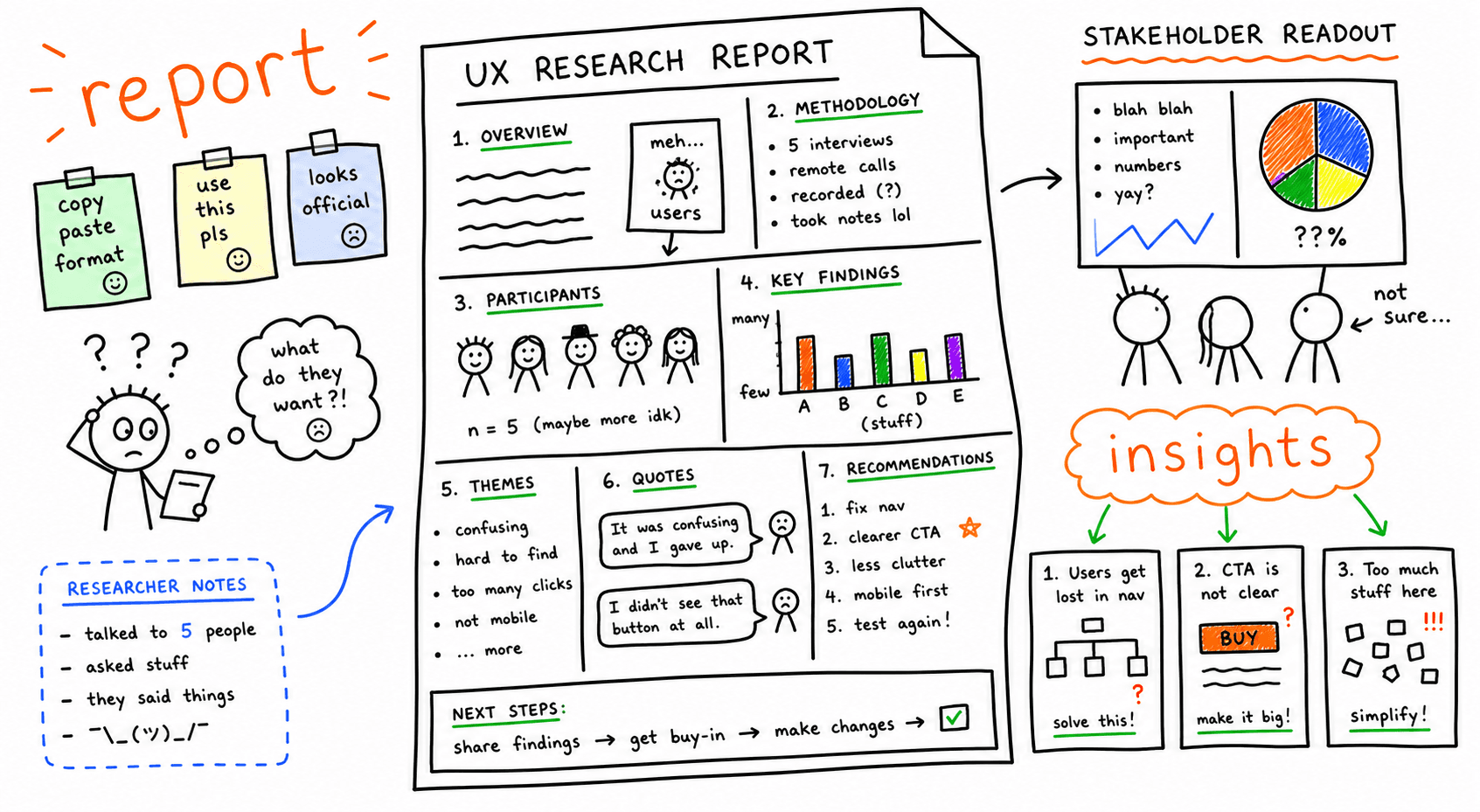

Most UX reports fail for one reason: they describe what happened, but not what to do next.
This ux research report template is built for decision-making. It helps you move from notes and recordings to a concise, evidence-backed report with clear priorities.
If you are still planning your study, start with the UX research plan template and research brief template.
What is a UX research report template?
A UX research report template is a reusable structure for documenting:
- the research goal and scope,
- the method and sample,
- key findings with evidence,
- and recommended actions with priority.
Use it after interviews, usability tests, concept tests, or mixed-method studies where teams need to align quickly.
When to use this template
Use this user research report template when you need to:
- brief product and engineering on what changed,
- defend design decisions with evidence,
- prioritize fixes before a release,
- show research impact to stakeholders.
For website-specific execution, pair this with Website UX Checklist, Usability Testing Template, and Website Usability Test.
UX Research Report Template (Copy/Paste)
Use this as-is in Docs, Notion, or Confluence.
1. Report Header
- Project:
- Product/Area:
- Research owner:
- Date:
- Version:
- Audience:
2. Executive Summary (5 lines max)
- Goal:
- Top 3 findings:
- Highest-impact recommendation:
- Estimated business impact:
- Decision requested from stakeholders:
3. Research Scope and Method
- Research objective:
- Key questions:
- Method(s):
- Session dates:
- Number of participants:
- Participant segments:
- Known limitations:
4. Findings Table
| Finding | Evidence | Severity | Impact area | Recommendation | Owner |
|---|---|---|---|---|---|
Severity scale (example):
Critical: blocks task completion or revenue pathHigh: major friction likely to affect conversionMedium: usability issue with moderate impactLow: polish or clarity improvement
5. Prioritization Matrix
| Recommendation | Effort (S/M/L) | Impact (1-5) | Confidence (1-5) | Priority score |
|---|---|---|---|---|
Use Priority score = Impact x Confidence and review effort separately during planning.
6. Action Plan
- This sprint:
- Next sprint:
- Backlog:
- Dependencies:
- Risks if postponed:
7. Appendix
- Interview or test script
- Raw notes links
- Session recordings
- Tagged observations
- Open questions for follow-up
Example: Filled Summary Block
Use this short block as your first slide or first screen in a ux research presentation template.
- Goal: Diagnose why users abandon the pricing-to-signup flow.
- Method: 8 moderated usability tests + analytics review.
- Finding 1: Users misread annual pricing as monthly.
- Finding 2: Trust signals appear below the fold on mobile.
- Finding 3: Error copy on trial form is unclear.
- Recommendation: Clarify pricing labels, move proof above fold, rewrite error states.
- Decision needed: Approve copy and layout changes for sprint 14.
If your project is conversion-heavy, cross-check findings with How to Improve Website Conversion Rate and Conversion Rate Optimization Checklist.
Make Your Findings Hard to Ignore
A strong ux research findings template should make each finding easy to challenge and easy to implement.
For each finding, include:
- one behavior statement (what users did),
- one evidence snippet (quote, clip, metric),
- one impact statement (what this affects),
- one recommendation (what to change now).
Weak finding:
- "Users seemed confused on checkout."
Strong finding:
- "5/8 participants missed shipping cost until step 3; 3 exited after seeing the final total. Add shipping estimate on cart page before checkout starts."
Stakeholder Readout Format (15 Minutes)
Use this readout sequence to keep meetings focused:
- Business goal and research question (2 min)
- Method and confidence limits (2 min)
- Top 3 findings with evidence (6 min)
- Priority actions by owner (4 min)
- Decision and deadline (1 min)
For report-ready outputs, align this with Website Audit Report Template and Site Audit Report.
Common Mistakes in UX Reports
- Reporting observations without decisions.
- Listing too many findings with no prioritization.
- Mixing assumptions and evidence in the same statement.
- Hiding limitations until after decisions are made.
- Skipping owner assignment and due dates.
Internal Linking Workflow for Website Teams
If your research is about website UX, connect this report to adjacent execution docs:
- Discovery inputs: User Interview Template, User Interview Questions Template
- Journey context: User Journey Mapping Template
- Evaluation checks: Website UX Checklist, Website Usability Checklist
- Prioritized implementation support: Website UX Audit, Website Content Analysis
FAQ
How long should a UX research report be?
Most teams get better adoption with 1-2 pages for the summary plus an appendix for detailed evidence.
What is the difference between a UX report and a UX presentation?
A report is the durable source of truth; a presentation is the live narrative for alignment. Build both from the same template so recommendations stay consistent.
Should we include raw notes in the report?
Yes, but keep them in the appendix. Decision-makers need concise findings first, then traceable evidence if they want to dive deeper.
Next Step
Use this template on your next research cycle, then run a page-level check with Website UX Audit to validate whether the prioritized fixes improve clarity, usability, and conversion paths.