Jera Value

How to get web design clients with a website audit
To get web design clients with a website audit, choose businesses whose website has a problem that you can fix. Audit one important page of each site. Then send the owner a short message with two or three findings, the proof and one question. The audit shows the prospect a problem on their own site, so it gives them a reason to reply. When they reply, the findings become the start of your proposal.
This method does not replace referrals, a portfolio or a good network. It is a way to start a conversation with a business that does not know you yet. It also works for SEO consultants and web developers, and the sections below show what to change for each type of work.
Why an audit gets more replies than a portfolio link
A portfolio shows your work on other people's websites. A business owner must then imagine what you could do for their own site, and most owners do not have time for that. An audit removes that step, because it shows a problem on their page, the proof and the change that you would make.
An audit also shows that you looked at their business before you wrote to them. Most cold messages to business owners are general offers, and owners learn to delete them. A message that names their headline, their contact form or their phone layout is different. It is also useful to the owner, even if they never hire you.
Do not expect every message to get a reply. The number of replies depends on the businesses that you choose, the problems that you find and how you write the message. Send a small batch first, count the replies, and change one thing at a time.
How to find website design clients with an audit, step by step
Use these steps for each batch of prospects. A batch of 10 to 20 businesses is enough to learn what works before you send more.
- Choose one type of business. For example, choose dental clinics in one city or online shops that sell one type of product. One type makes the research faster and makes your message more specific.
- Make a list of businesses that need help. Look for sites with a slow phone page, an unclear first screen, an old design or no clear way to contact the business.
- Audit one page of each site. Choose the homepage or the page that brings the business its customers, such as a booking page.
- Check the findings yourself. Open the live page and confirm each finding that you plan to send. Delete the findings that do not fit the business.
- Choose two or three findings. Choose problems that cost the business customers, and that you can fix in a small first project.
- Add your brand to the report. Add your logo, your name and a "Book a call" button, so the report comes from you.
- Send a short message. Put one finding in the message, link to the full report and ask one question.
- Follow up once. If the owner does not reply, send one short follow-up after about a week. Then stop.
The steps take more time than a general message, so do not try to audit hundreds of sites. Ten good audits and ten specific messages can teach you more than two hundred general emails.
What to put in the audit that you send
Send a short audit, not a long technical report. A business owner reads a report to answer one question: "Is this person worth a call?" Two or three clear findings with proof answer that question better than 40 findings that the owner does not understand.
Each finding needs three parts: what you saw, why it matters to the business and what you would change. The proof can be a screenshot with the problem marked, a quote from the page or a measured value, such as a load time. Then tell the owner the scope of the audit in one sentence. For example: "I looked at your homepage only, on October 20, without your analytics."
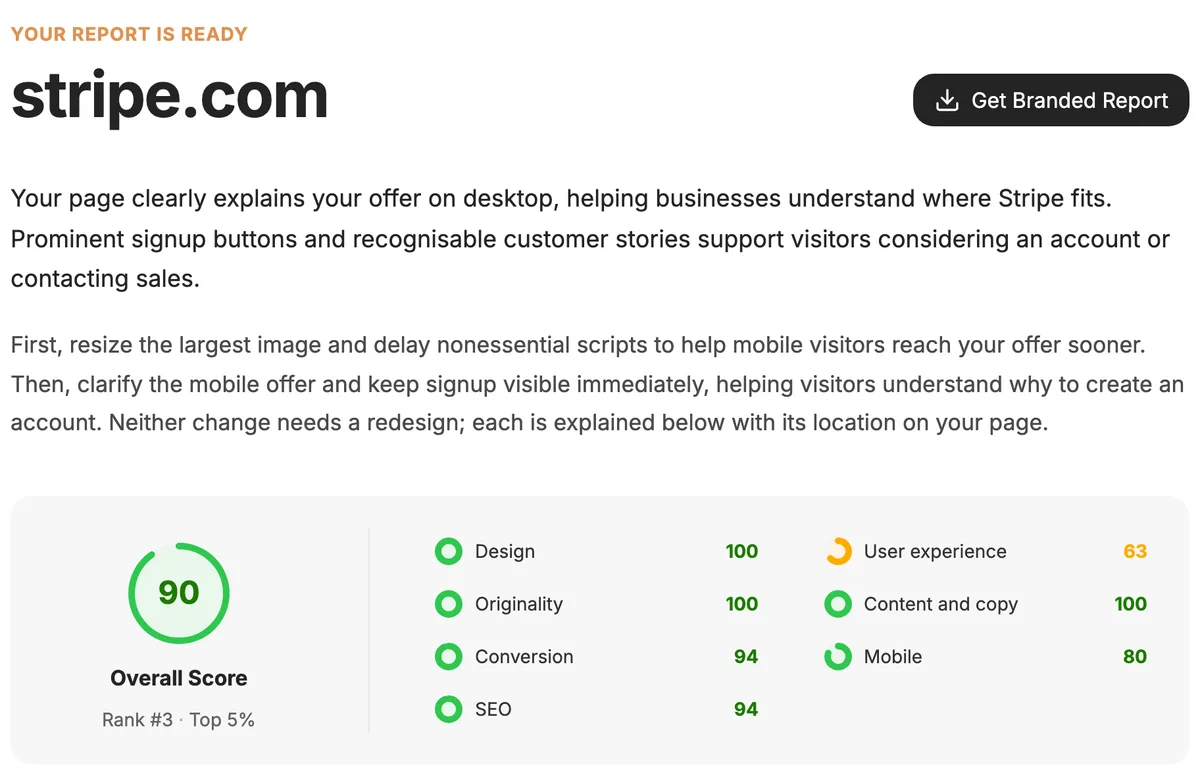
Our sample website audit report shows a real report of the stripe.com homepage with our notes. It shows the proof for each finding, the priority labels and the one finding that we would edit before we send the report to a client. Use it as a model for the level of detail that a prospect can read in two minutes.
Do not promise results that you cannot prove. An audit of one page without analytics can show a problem, but it cannot prove how many sales the business loses. Write "This can make visitors leave before they book" and not "This costs you 30% of your bookings."
A short message that you can adapt
Keep the first message short enough to read on a phone. Name one specific problem, give the link and ask a question that is easy to answer. Change the words so that the message sounds like you.
Subject: Your booking page on phones
Hi [Name],
I looked at the [Business] website on my phone. The "Book now" button is below three screens of text, so a visitor must scroll a lot before they can book.
I wrote a short report with this problem and two others, with screenshots and the change that I would make for each one: [link to the report]
Would it help if I sent you a quote to fix these three things?
[Your name]
[Your website]
The question at the end asks for a small decision. A quote for three fixes is easier to accept than a full redesign, and a small first project lets the owner see how you work. When the owner says yes, you can offer the larger project.
Follow the email rules of your country and of the prospect's country. Send each message to a real business address, say who you are and stop when someone asks you to stop.
How to get SEO clients with the same method
To get SEO clients with an audit, show the owner one or two search problems on their main page. Good examples are a page title that does not name the service, a missing meta description or a page with no H1 heading. A slow page on phones is another good example. These problems are easy for an owner to see, and you can explain each one in one sentence.
An audit of one page is an opening for an SEO client, not the full SEO audit. The full audit needs a crawl of the site, the client's Search Console data, rankings and backlinks. Do that work after the client agrees to a project, and put it in your proposal as the first phase.
A Roast My Web report checks on-page SEO signals and runs one simulated mobile speed test for the page. The report does not crawl the whole site, track rankings or check backlinks. If an SEO prospect asks for those, tell them that they are part of the paid project.
How to get clients for web development
To get clients for web development, look for technical problems that the owner can see. Good examples are a slow phone page, a broken layout on phones, a contact form that does not work and a long checkout. A developer can fix each of these in a clear, small project.
Speed numbers need care. A speed test gives a slightly different result each time that you run it. So run the test again before you send a number to a prospect, and write the date of the test in the message.
If you want clients in another country, choose businesses in that country and write the message for that market. Use the prices, the currency and the language that the business uses. A specific audit of a local business tells that owner more about you than a general offer from abroad.
How to turn the audit into a proposal
The audit makes the first part of the proposal easy to write. Each finding becomes one item of work, with the problem, the change and the price. Put the Do first findings in the first phase and the other findings in a later phase. The client can then start with a small project.
Our website redesign proposal template shows the sections of a full proposal, from the scope to the payment terms. Its first section, "What we found on your current site", is where the audit findings go, and they help you write the scope. The client then sees the reason for each part of the work.
How Roast My Web helps with this work
Roast My Web audits one public page and writes a report with scores, findings and proof. Each finding has a priority label: Do first, Plan it or Nice to have. Before you send the report, you can edit each finding, change its priority or delete it. You know the client's business better than the audit does.
You can add your logo, company name, website, brand color and a call-to-action button, such as "Book a call". With the neutral address turned on, new shared report links open on audits.page, and the page there shows no Roast My Web branding. You can also send the report as a PDF.
Each Roast My Web audit covers one public page and uses one credit. Roast My Web sells credits in one-time packs, not by subscription: 6 credits for $4, 24 credits for $12 and 1,200 credits for $299. So a batch of 24 prospect homepages costs $12 with the 24-credit pack. The store page shows the current prices.
See how client reporting works, with branding, the neutral address and the report editor.
Frequently asked questions
Is it acceptable to audit a business that did not ask for it?
Yes, if you audit only the public page and you write to the owner politely. Do not publish the audit, and do not criticize the business in public. Offer the report as help, and accept a "no" at once.
How many findings should I send to a prospect?
Send two or three findings in a first message. More findings make the message longer and make the work look larger than it is. Keep the other findings for the call or for the proposal.
Should the audit be free?
The first short audit is usually free, because it starts the conversation. The full audit, the fixes and the redesign are the paid work. Write the boundary clearly in your proposal, so that the client knows what the free audit did not include.
Can I use a blank template instead of a tool?
Yes. Our free website audit report template gives you a blank report structure, and the website audit checklist lists what to check. A tool is faster when you audit many prospects, but you must check its findings in both cases.