Jera Value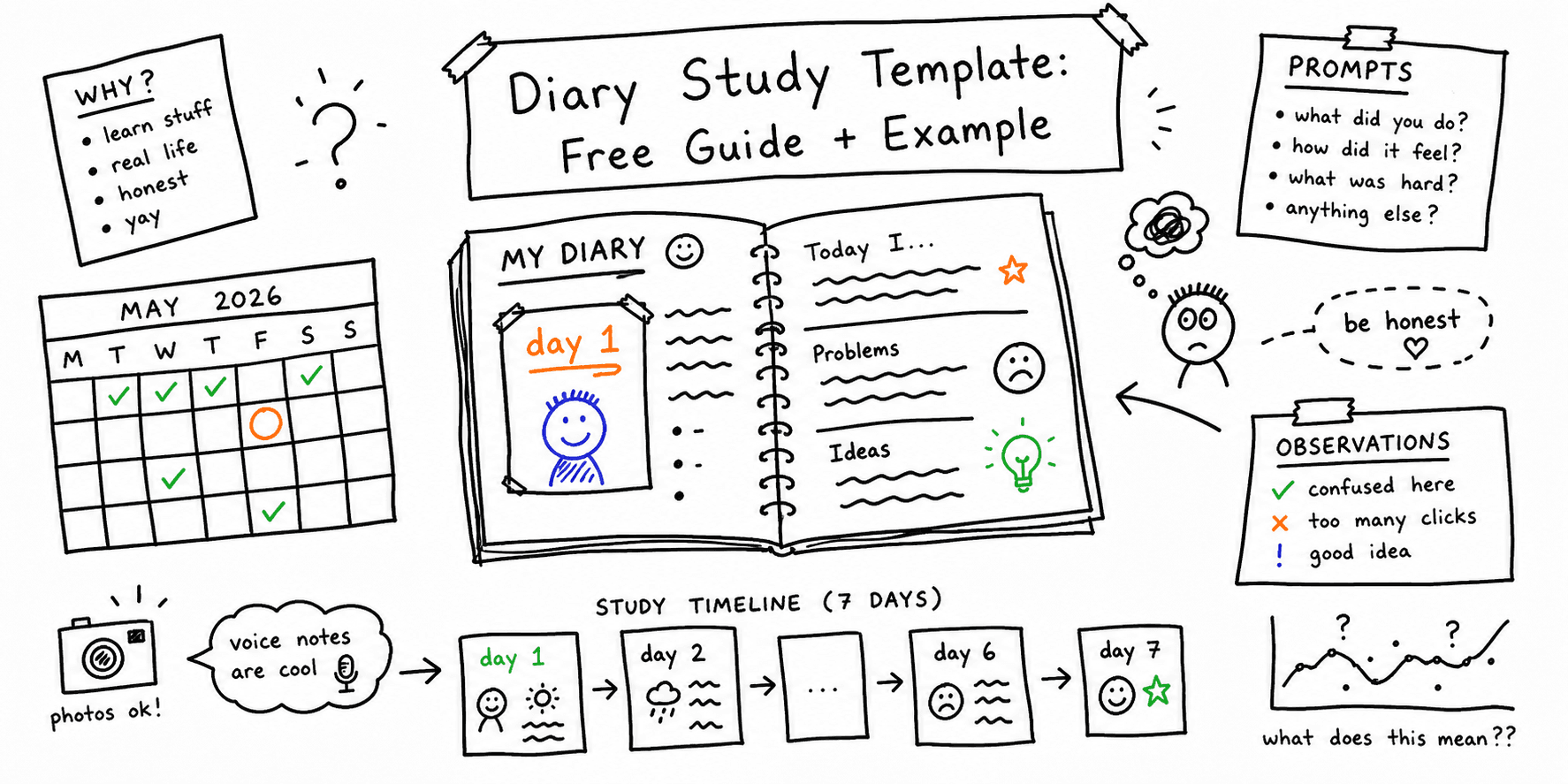

Diary studies capture real-world behavior over time. This template helps you keep prompts consistent, schedule entries, and simplify analysis.
What you'll get:
- A copy/paste diary study template
- Entry schedule options (event, interval, signal)
- A simple analysis checklist and mini example
Use the sections below as building blocks; keep what you need and delete the rest.
Before recruiting, use the user research screener template.
References for this guide are listed at the end.
What is a diary study?
Nielsen Norman Group defines diary studies as a qualitative method for collecting user behaviors, activities, and experiences over time and in context. User Interviews adds that participants keep a log of experiences over time in many formats, often as a remote alternative to field studies.
When to use a diary study
Diary studies are useful for long-term or repeated behaviors, changes in perception over time, and end-to-end journeys. Nielsen Norman Group lists habits, motivations, behavior changes, and customer journeys as common research areas.
How diary entries are captured
Nielsen Norman Group describes three common diary entry methods:
- Event-based: participants log an entry when a specific event happens
- Interval-based: participants log at regular times
- Signal-based: participants log when prompted by a reminder or signal
Typical diary study timeline
User Interviews notes that diary studies can run from a few days to a few months, and recommends keeping the study as short as possible while still answering the research question. They also recommend a short interview at the start and end, plus regular check-ins to keep participants engaged.
Diary study template (copy/paste)
1. Research goal and scope
- What behavior or journey are you studying?
- What decisions will this inform?
- What is in and out of scope?
2. Study structure
Dscout frames diary templates as a warm-up, a middle of moments or feedback, and a wrap-up. Use that structure to shape your study.
- Warm-up: baseline questions about current behavior
- Moments: repeated entries over time
- Wrap-up: reflection and summary
3. Entry schedule
- Choose event-based, interval-based, or signal-based logging
- Define entry frequency and required minimums
- Add reminders or prompts if needed
4. Participant plan
- Target users:
- Sample size:
- Recruiting method:
Nielsen Norman Group suggests sample sizes vary by scope, with roughly 5 to 12 for smaller discovery studies and 12 to 30 for larger discovery work.
5. Tools and logistics
Nielsen Norman Group recommends selecting tools based on the type of data you need, and notes options from general survey tools to specialized diary study platforms. Miro positions diary templates as a structured way to document experiences over time with reflection.
6. Incentives and expectations
Nielsen Norman Group recommends being clear about minimum response requirements and aligning incentives to the time commitment.
7. Communication plan
User Interviews recommends regular check-ins throughout the study to keep participants engaged and clarify questions.
Diary entry form (copy/paste)
Looppanel describes diary study templates as prompts and open-ended questions that capture in-the-moment experiences. Use the fields below as a starting point.
| Field | Prompt |
|---|---|
| Participant ID | |
| Date and time | |
| Context | Where are you? What are you doing? |
| Activity | What task or goal were you trying to complete? |
| Device or channel | Web, mobile, in person, other |
| What happened | Describe the experience in detail |
| Feelings | How did this make you feel? |
| Issues or frictions | What went wrong, if anything? |
| Workarounds | How did you handle it? |
| Evidence | Screenshot, photo, or link (optional) |
| Follow-up | Anything else to add? |
Optional daily recap prompts from Miro-style journaling:
- What went well today?
- What was frustrating today?
- What is one thing you would change?
Warm-up questions (optional)
Use these to set context before the diary period begins.
- How often do you do this activity today?
- What tools or services do you use now?
- What is the hardest part of the process?
- What does success look like?
Wrap-up interview prompts
Use a short interview to summarize themes and resolve unclear entries.
- What patterns did you notice in your own behavior?
- Which moments were most frustrating or surprising?
- If you could change one part of the experience, what would it be?
Analysis checklist
- Review entries by timeline and participant
- Tag recurring behaviors or pain points
- Identify context patterns (time, device, location)
- Summarize key moments and quotes
- Map insights to product opportunities
Mini example (filled in)
Goal: Understand how users track workouts over 2 weeks
Method: Signal-based prompts twice per day
Entries: Short logs with screenshots of workouts
Insight: Users skip logging when reminders arrive during commute hours
FAQ
How long should a diary study run?
User Interviews notes diary studies can run from a few days to a few months, and recommends keeping them as short as possible while still answering the research question.
What diary entry method should I choose?
Nielsen Norman Group outlines event-based, interval-based, and signal-based logging. Choose the method that best fits how frequently the behavior occurs.
Are diary studies a replacement for field studies?
User Interviews notes diary studies can be a remote alternative to field or ethnographic studies when in-person observation is not practical.
References
- Nielsen Norman Group — Diary Studies
- User Interviews — Diary Study
- Looppanel — Diary Study Template
- Miro — Diary
- dscout — Diary Templates Overview
Related resources
- UX research plan template
- User interview template
- Usability testing template
- UX audit template
- Heuristic evaluation template
If you want a fast UX review for a specific page, start here: Website UX Audit
Want client-ready UX findings in minutes? Roast My Web generates branded PDF audit reports with prioritized UX, conversion, and SEO fixes.