Jera Value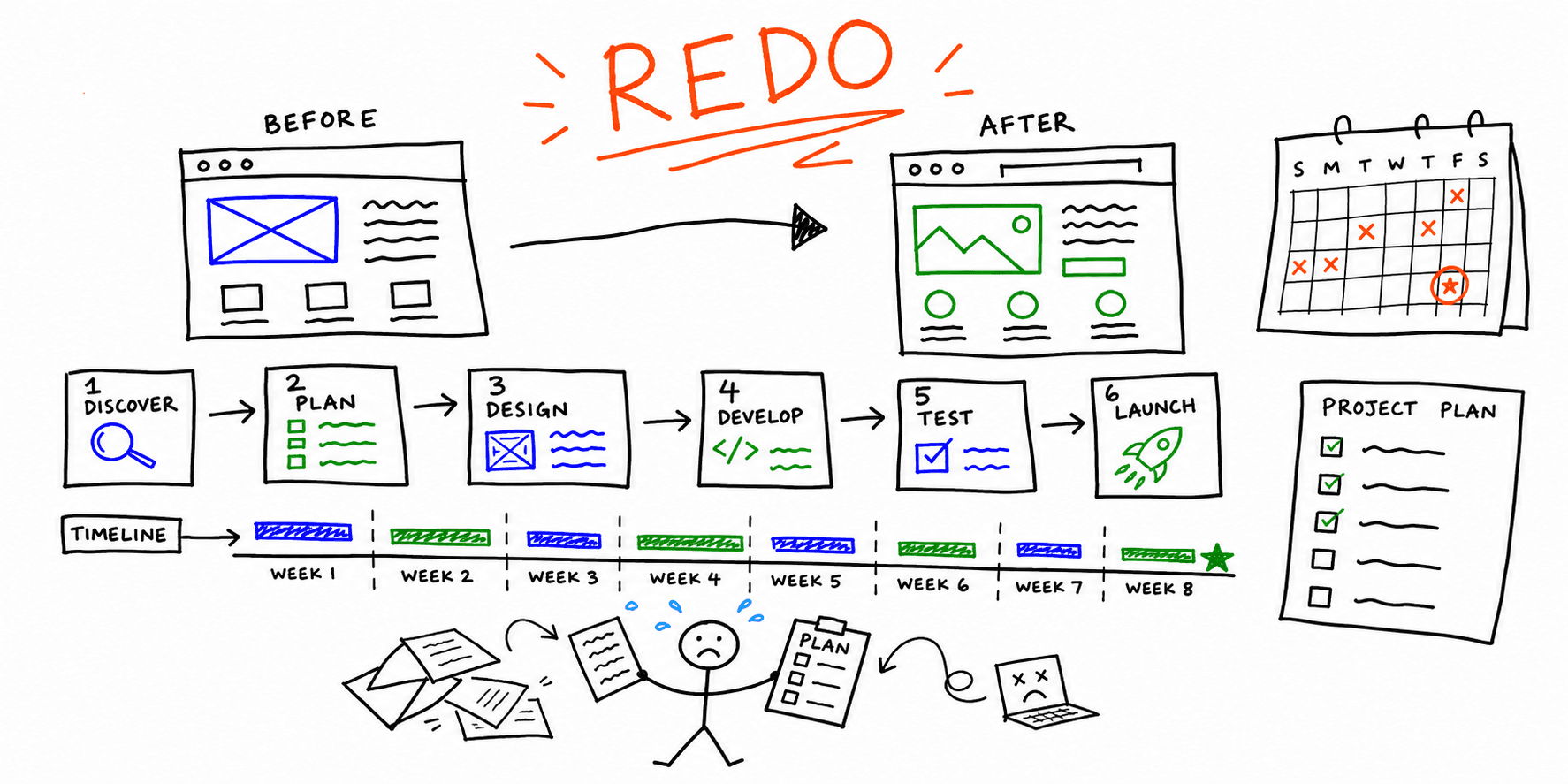

Most teams shopping for website redesign services get stuck between two bad options: vague retainers or scope-heavy proposals that miss outcomes. This guide gives you both: a practical redesign process and a service-buyer framework so you can pick the right partner, set a realistic scope, and protect organic traffic during launch.
Need baseline inputs before kickoff? Start with a website audit tool, website design audit, and site performance audit.
Website redesign process overview
A strong process includes:
- A clear business goal and conversion KPI
- User and content evidence from the current site
- A page-level SEO and redirect plan
- A phased build, QA, and launch workflow
- Post-launch monitoring with weekly checkpoints
Website redesign services: how to evaluate partners fast
When comparing website redesign service providers, use one scorecard so legal, marketing, and product are evaluating the same criteria.
| Evaluation factor | What to verify | Why it matters |
|---|---|---|
| Strategy depth | Do they produce page-level goals and KPI assumptions before design starts? | Prevents expensive visual work that fails to improve conversion or retention. |
| SEO migration readiness | Can they show redirect logic and pre-launch technical SEO QA examples? | Reduces ranking volatility during launch. |
| UX research quality | Do they include interviews, recordings, or test plans instead of only opinions? | Improves decision quality on IA, copy, and interaction patterns. |
| Build and analytics instrumentation | Do they define event tracking and QA ownership before release? | Prevents blind launches where conversion changes are hard to explain. |
| Stabilization support | Is there a 30- to 60-day post-launch triage plan? | Most redesign regressions show up after go-live, not before. |
Use this table inside your website redesign proposal template, then validate assumptions with a website audit report and website audit company baseline.
Website redesign process in 7 phases
| Phase | Main outcome | Primary owner |
|---|---|---|
| 1) Baseline and audit | Clear list of problems and opportunities | Growth + UX |
| 2) Goals and scope | Approved objectives, KPIs, and boundaries | Marketing lead |
| 3) Information architecture | Final sitemap and navigation logic | UX lead |
| 4) Content and SEO mapping | URL map, metadata plan, redirect sheet | SEO lead |
| 5) Design and build | Working templates with content and tracking | Design + Engineering |
| 6) QA and launch prep | Release-ready site with known risks closed | QA lead |
| 7) Launch and stabilization | Stable rankings, conversion tracking, and fixes | PM + SEO |
1) Baseline and audit
- Pull conversion, traffic, and speed baselines for the last 90 days
- Flag top revenue pages and highest-exit pages
- Run a focused UX and content review on key journeys
Useful starting points:
2) Goals and scope
- Define primary conversion goal (demo, signup, checkout)
- Set one primary KPI plus 2 to 3 support KPIs
- Lock in scope: included templates, excluded templates, and constraints
3) Information architecture
- Approve core navigation and sitemap
- Validate key user paths with quick testing
- Decide page priorities for phase-one launch
4) Content and SEO mapping
- Build old URL to new URL mapping
- Assign target query intent by high-value page
- Draft metadata and internal links before development starts
For this step, use:
5) Design and build
- Create wireframes and production-ready components
- Implement templates and analytics events
- Build for mobile-first performance targets
6) QA and launch prep
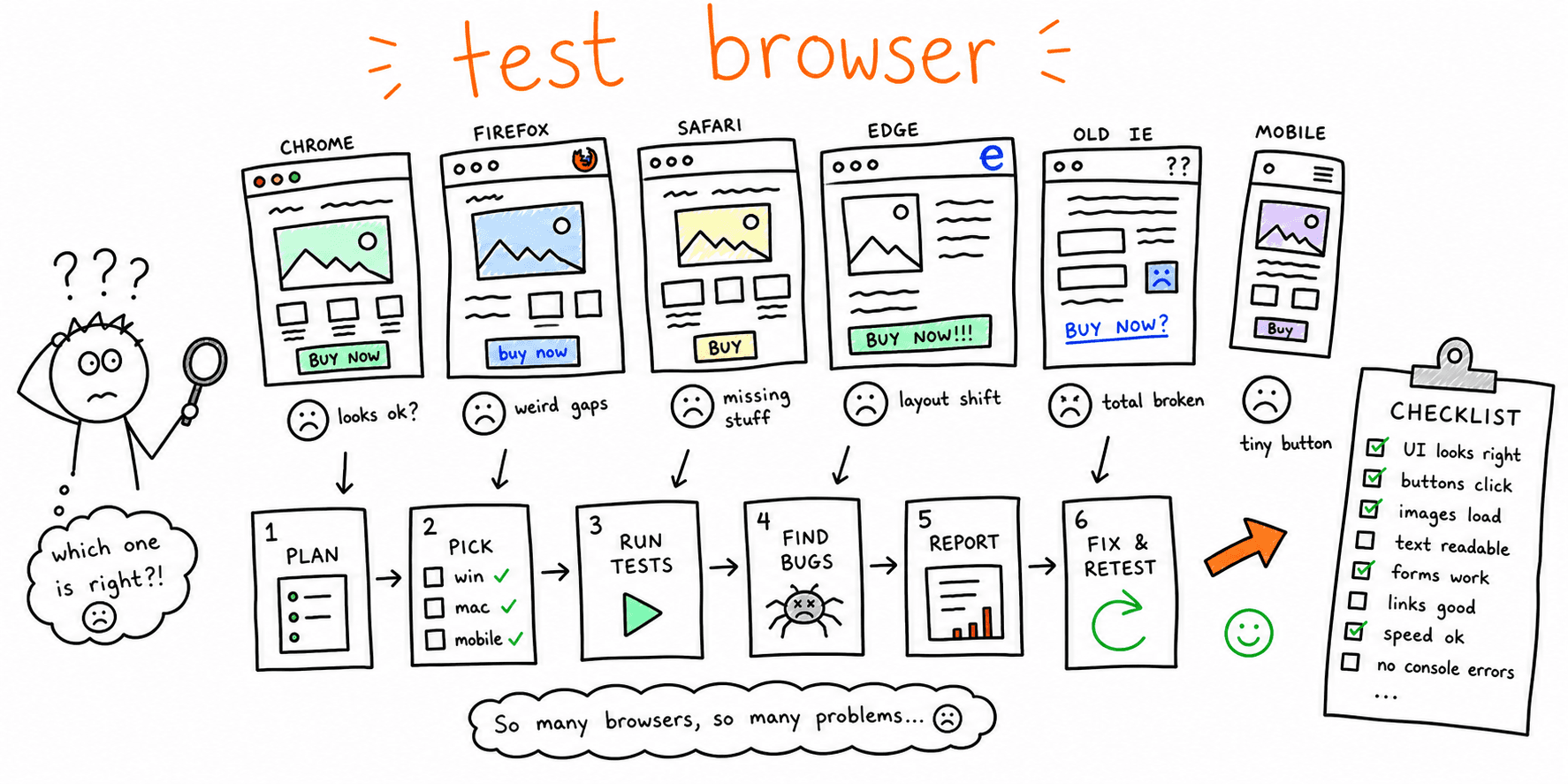
- Test core flows across browsers and devices
- Validate redirects, canonicals, and internal links
- Confirm event tracking and goal definitions
Use:
7) Launch and stabilization
- Monitor rankings, errors, and conversion changes daily for 14 days
- Fix redirect gaps, indexation issues, and tracking regressions fast
- Run weekly performance and UX tuning in weeks 3 to 8
Website redesign timeline (12-week model)
Use this timeline as your default. Compress or expand based on team size and template count.
| Weeks | Milestone | Deliverables |
|---|---|---|
| 1-2 | Baseline and scope | KPI sheet, risk register, approved scope |
| 3-4 | IA and content plan | Sitemap, key-page outlines, keyword map |
| 5-7 | Design and prototype | Wireframes, UI system, stakeholder sign-off |
| 8-10 | Development | Implemented templates, tracking, redirects |
| 11 | QA and pre-launch checks | Test logs, SEO sign-off, release checklist |
| 12 | Launch and monitoring | Live release, issue triage, 14-day dashboard |
If your scope includes major URL changes, pair this timeline with the website migration service guide.
Small business website redesign: scope before spend
A small business website redesign fails when scope is set by page count alone. Scope should reflect revenue path complexity.
Use this quick sizing model:
- Starter scope (5-15 pages): core pages, light SEO mapping, and analytics cleanup.
- Growth scope (15-40 pages): service/product template redesign, conversion path testing, stronger internal-link architecture.
- Complex scope (40+ pages): multi-template migration, redirect governance, staged rollout, and structured post-launch monitoring.
For small teams, prioritize sequence over perfection:
- Fix top 20% of pages that drive most leads or sales.
- Ship technical and tracking reliability before visual polish.
- Run the website launch checklist with weekly KPI reviews.
If you need pre-redesign evidence, start with website design audit and technical website audit.
Website redesign package examples
Use package language to make proposals comparable and prevent scope drift.
| Package type | Best for | Typical inclusions |
|---|---|---|
| Core redesign package | SMB sites with one primary conversion | IA cleanup, 5-10 key templates, essential SEO mapping, pre-launch QA |
| Growth package | Teams scaling inbound + paid traffic | CRO copy pass, template system updates, analytics plan, launch and 30-day support |
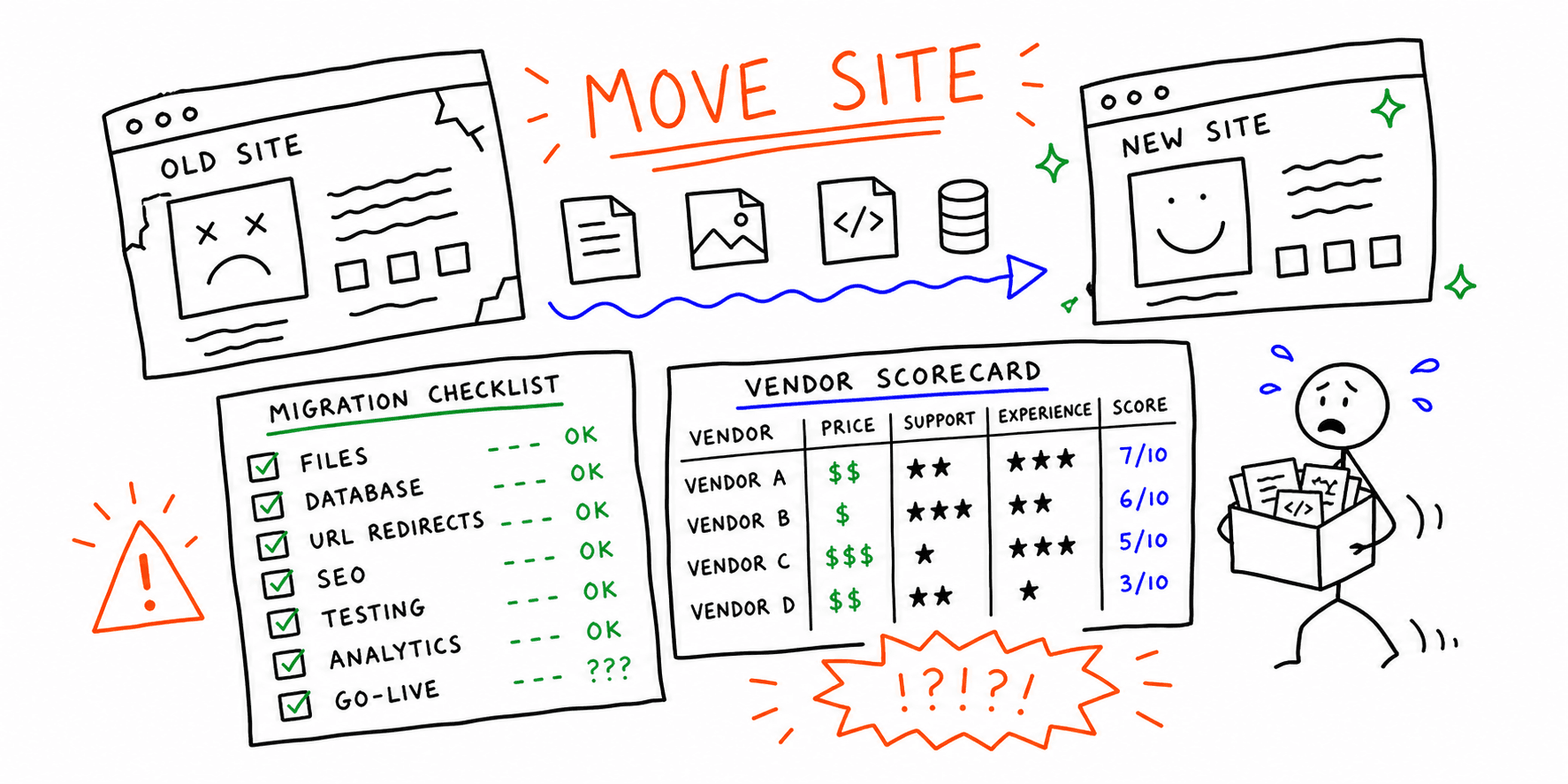
| Replatform package | CMS migration or major URL restructuring | Redirect governance, technical SEO QA, phased launch, 60-day stabilization |
Before signing any website redesign package, require:
- Deliverable-level acceptance criteria
- Named owners for SEO, analytics, QA, and PM
- A rollback path and launch-week escalation contact list
Pair package decisions with website redesign requirements so scope and SEO controls stay aligned.
Website redesign examples (case study patterns)
If you need website redesign examples for stakeholder buy-in, use these three patterns. Each can be documented as a lightweight website redesign case study with baseline, intervention, and outcome.
| Example pattern | Baseline problem | Redesign moves | 30-60 day outcome to track |
|---|---|---|---|
| B2B lead-gen homepage overhaul | High bounce rate and low demo conversion on core landing page | Clarified hero value prop, simplified nav, moved social proof above the fold | Bounce rate, demo form starts, demo form completion rate |
| Ecommerce category page cleanup | Strong traffic but weak product page click-through | Reworked category IA, added filters, tightened internal links to top products | Category-to-product CTR, add-to-cart rate, revenue per session |
| Services site trust rebuild | Lots of branded traffic but low contact form quality | Added focused service pages, case-study blocks, and stronger CTA segmentation | Qualified lead rate, form quality score, assisted conversion volume |
Support these examples with baseline evidence from a website audit checklist, UX findings from website redesign requirements, and launch controls from the website launch checklist.
Website redesign case study template (quick structure)
Use this 5-part structure to document your own website redesign case study:
- Context: site type, traffic profile, and business goal.
- Baseline metrics: conversion rate, top-exit pages, and SEO visibility before changes.
- Redesign decisions: what changed in IA, copy, design system, and technical SEO.
- Measured impact: 30-day and 60-day deltas with exact metric definitions.
- What to do next: backlog items for iteration 2.
For reporting, combine this structure with your sample website audit report and the site audit report generator.
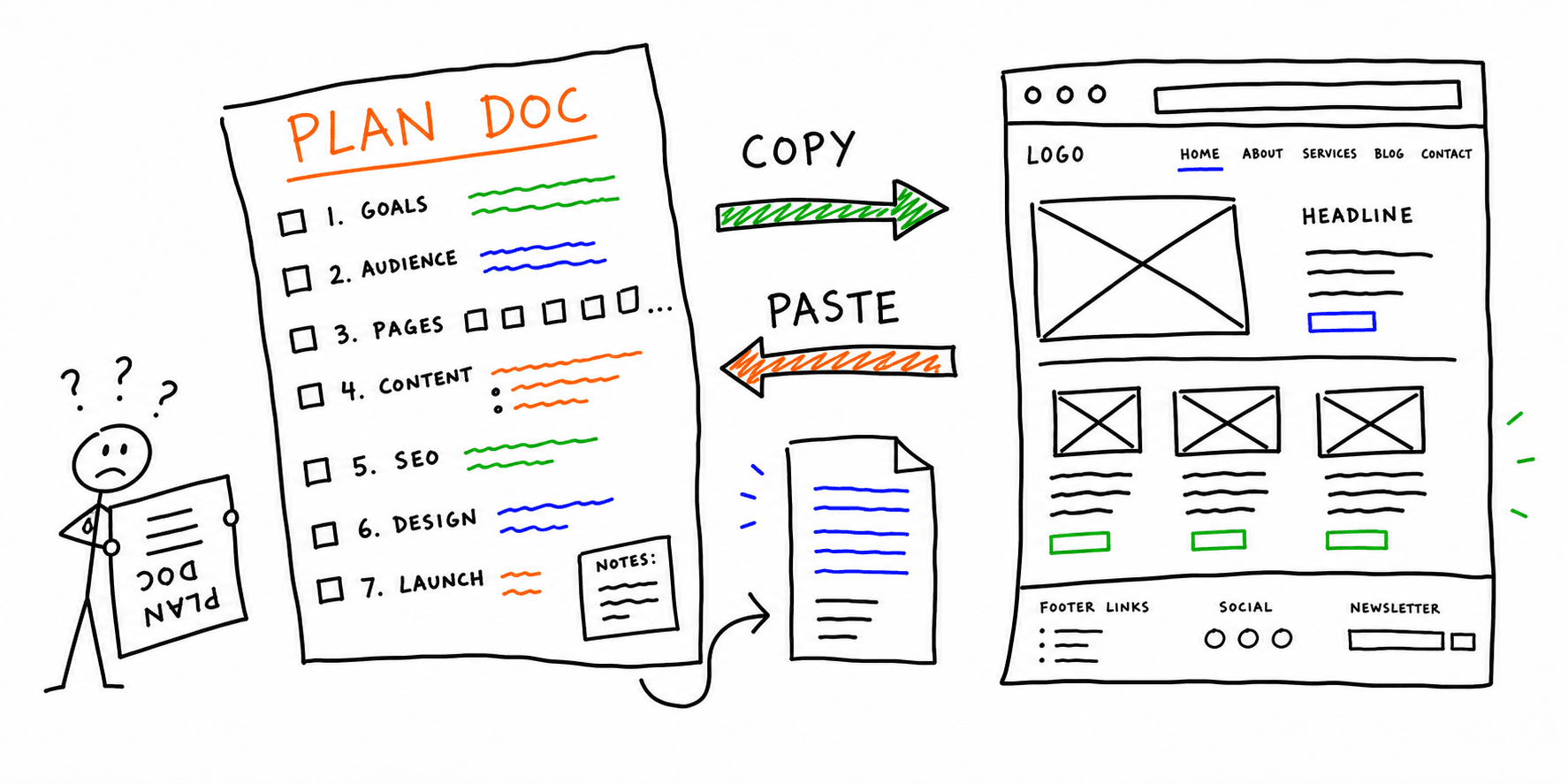
Website redesign project plan template (copy/paste)
Use this template in Sheets, Notion, or your PM tool.
| Workstream | Task | Owner | Start | End | Dependency | KPI |
|---|---|---|---|---|---|---|
| Strategy | Approve goals and target metrics | Marketing lead | W1 | W1 | Stakeholder interviews | KPI sheet signed |
| UX | Finalize sitemap and key journeys | UX lead | W2 | W3 | Analytics baseline | Journey map approved |
| SEO | Complete URL map and redirect plan | SEO lead | W3 | W5 | Final sitemap | 100% mapped URLs |
| Design | Approve homepage + money-page designs | Design lead | W4 | W7 | IA sign-off | Design approval |
| Dev | Build templates and integrate analytics | Engineering | W7 | W10 | Approved designs | Tracking QA pass |
| QA | Cross-device and SEO preflight | QA + SEO | W10 | W11 | Feature complete | Critical issues = 0 |
| Launch | Release + 14-day stabilization | PM | W12 | W14 | QA sign-off | No severe regressions |
Keep a single source of truth and update owners every week. Most redesign delays come from unclear dependencies, not engineering effort.
Redesign metrics to track for 60 days
- Conversion rate on top 3 money pages
- Organic sessions and query coverage on migrated URLs
- Core Web Vitals on mobile templates
- Form completion, CTA click-through, and bounce rate
Need a fast benchmark baseline? Run website analysis online and compare it to your website audit checklist findings.
Related resources
- Website redesign requirements
- Website redesign proposal template
- Website launch checklist
- Landing page structure checklist
- SEO on-page analysis
Final thoughts
A clear website redesign process reduces rework and protects SEO performance. Start with the baseline, run the 12-week timeline, and execute a project plan with named owners and measurable checkpoints.