Jera Value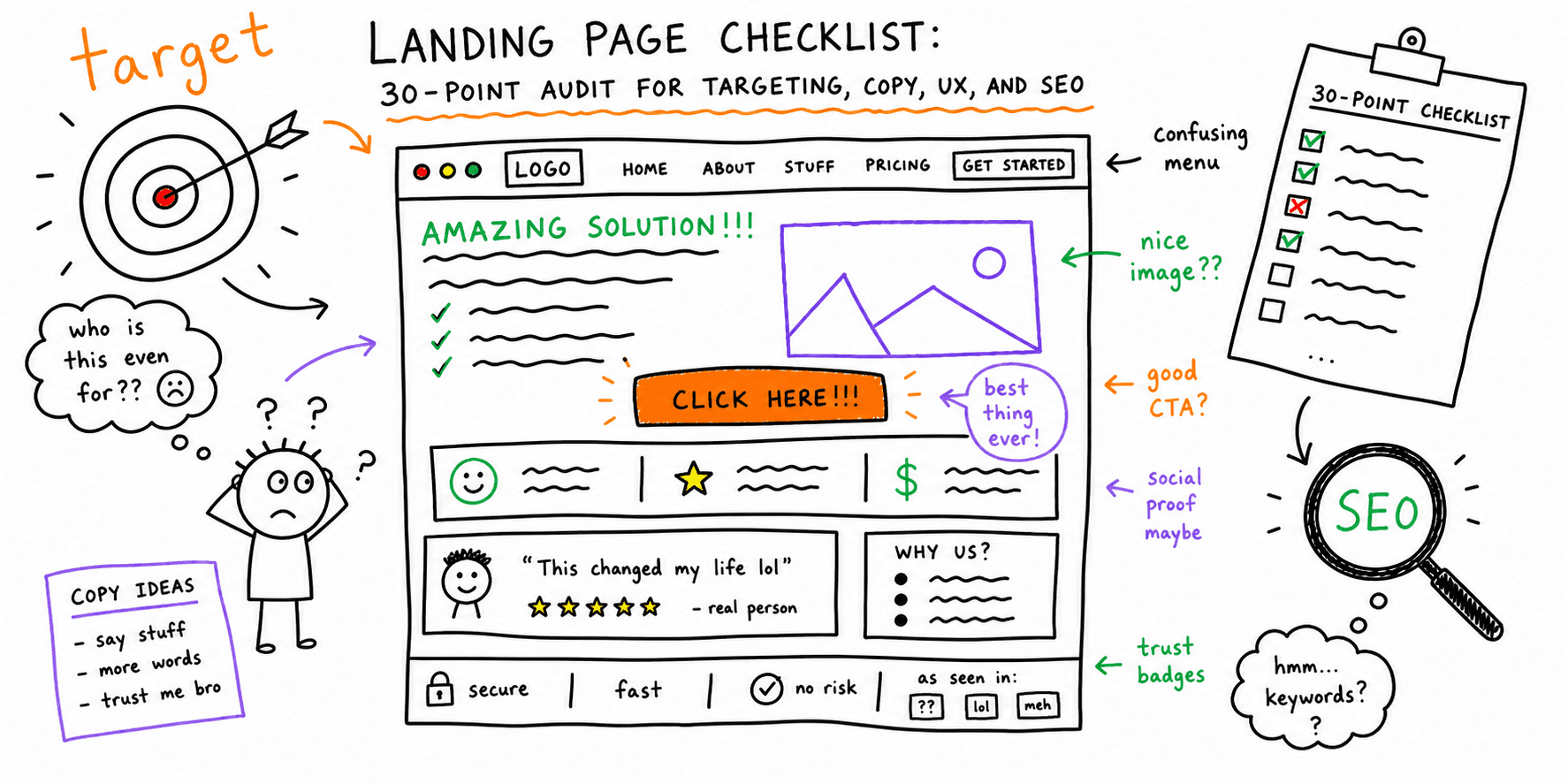

Landing Page Checklist (How to Use It)
This guide is built for teams that want a practical landing page checklist before publishing or scaling paid traffic.
Use a simple 0 to 2 scoring system per item:
- 0 = missing or unclear
- 1 = partially complete
- 2 = complete and strong
A 30-point checklist scored this way gives a 60-point total.
- 40-50: launch-ready
- 30-39: launch with fixes queued
- Below 30: fix first, then scale spend
If you need a second opinion after scoring, run your page through the Landing Page Analyzer.
1) Audience and Offer Fit (Targeting)
This is the highest-leverage section of any landing page targeting checklist. If the audience-offer match is weak, better copy or design will not save performance.
- ICP is explicit in the hero You clearly state who this page is for (role, company type, use case, or stage).
- Primary pain point appears above the fold Visitors should not scroll to understand what problem you solve.
- Offer matches traffic intent Cold traffic should not see a hard-close CTA if it needs proof first.
- Disqualifier is present when needed Add a line such as "Not for freelancers" or "Best for teams 10+." This improves lead quality.
- One page = one audience If you serve multiple segments, build separate pages instead of forcing one mixed message.
For a deeper framework, use this alongside Landing Page Best Practices.
2) Message and Copy Clarity
Most conversion losses happen because the message is vague, generic, or feature-heavy.
- Headline states outcome, not category "Reduce churn from poor-fit trials" is stronger than "All-in-one platform."
- Subheadline explains mechanism One sentence on how you deliver the promised result.
- Copy answers "Why now?" Add urgency based on risk, opportunity, or timing.
- CTA text is specific Prefer "Get audit report" or "Start free analysis" over "Submit."
- Objections are handled in-page Address price, implementation time, data privacy, and migration anxiety.
If copy needs work, use Landing Page Copywriting as the companion guide.
3) UX and Form Friction
A landing page optimization checklist must include interaction quality, especially around forms and mobile layout.
- Primary CTA is visible without hunting The top CTA appears above the fold and at logical repeat points.
- Form fields are reduced to essentials Ask only for what your next step truly requires.
- Error states are helpful Messages explain what is wrong and how to fix it.
- Mobile layout is clean and readable Buttons are thumb-friendly, text is legible, and spacing is not cramped.
- No competing CTAs on the same page Avoid mixing "Book demo," "Start free," and "Download PDF" unless one is clearly primary.
For broader UX QA, cross-check with Website Usability Checklist.
4) Proof, Trust, and Conversion Confidence
Visitors convert faster when risk is low and proof is specific.
- Social proof matches target audience Use logos/testimonials from similar customers, not random names.
- Results are quantified Example: "Increased qualified demos by 31% in 6 weeks."
- Trust elements are near CTA Add guarantees, privacy notes, or security claims near form submission.
- Pricing expectations are clear enough Hidden pricing can kill intent quality if visitors feel surprised later.
- Page promise matches post-click experience If ad copy says "free audit," the first CTA should deliver exactly that.
If your trust layer feels weak, get a structured review via Landing Page Critique.
5) SEO and Technical Checks (Landing Page SEO Checklist)
This section helps you avoid indexing or relevance issues while keeping conversion intent intact.
- Primary keyword appears naturally Include "landing page checklist" in title, intro, and at least one subheading where appropriate.
- Meta title and description are aligned Metadata should reflect checklist intent, not generic landing page advice.
- One clear H1 and logical heading hierarchy Clean structure improves scannability and relevance.
- Image alt text is descriptive Avoid keyword stuffing; describe meaningfully.
- Core Web Vitals and page speed are acceptable Slow pages harm both paid and organic performance.
For page-level diagnostics, run SEO On-Page Analysis.
6) Measurement and Iteration Plan
A checklist only matters if it leads to repeatable improvement.
- Events are instrumented end-to-end Track view -> CTA click -> form start -> form submit -> qualified outcome.
- Segments are analyzed separately Break down by source, device, geography, and campaign.
- Quality metrics are defined Measure activation, pipeline quality, refund/churn rate, not just CVR.
- A/B test queue is prioritized Keep 3-5 hypotheses ranked by expected impact.
- Review cadence is scheduled Weekly checks for active campaigns, biweekly for steady-state pages.
To operationalize improvements, pair this with the Conversion Rate Optimization Checklist or request a full Conversion Rate Optimisation Audit.
Quick Scorecard Template
Copy this into your doc and score each section:
| Section | Max Score | Your Score |
|---|---|---|
| Audience and offer fit | 10 | |
| Message and copy clarity | 10 | |
| UX and form friction | 10 | |
| Proof and trust | 10 | |
| SEO and technical checks | 10 | |
| Measurement and iteration | 10 | |
| Total | 60 |
Interpretation:
- 48-60: strong page, focus on incremental testing
- 36-47: good baseline, fix weak sections before scaling traffic
- Below 36: messaging/targeting mismatch likely, address fundamentals first
Final Pre-Launch Pass
Before launch, do one live walkthrough from ad click to thank-you page and ask:
- Is the promise clear in five seconds?
- Is the CTA obvious and low-friction?
- Does the page attract the right people, not just more people?
If you want a fast benchmark against high-performing pages in your category, start with Roast My Landing Page.