Jera Value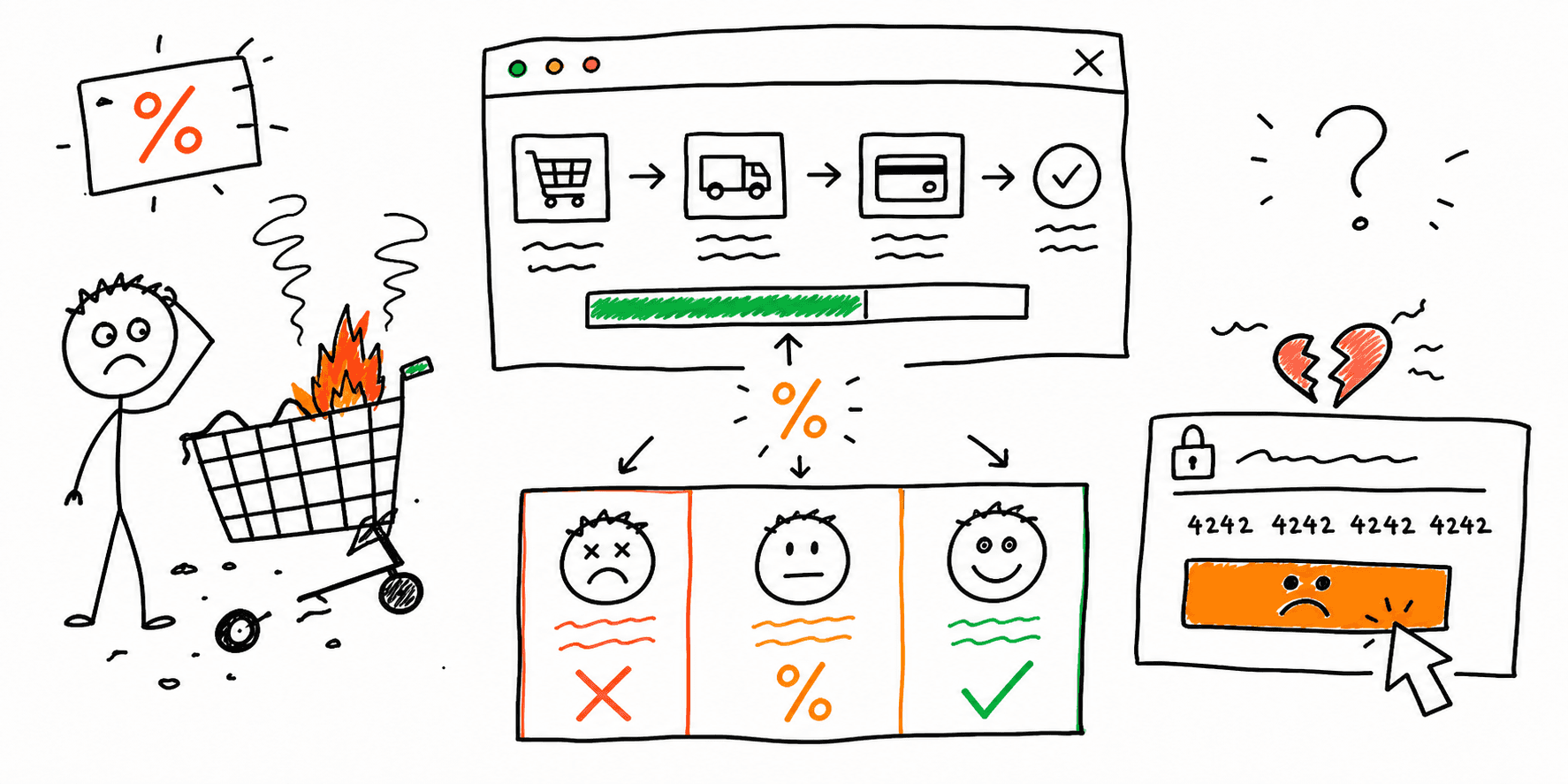

Checkout Completion Rate: The Metric That Shows If People Finish Checkout
If you want to know how many people actually finish checkout after they start, you want checkout completion rate. This metric answers a simple question: of the people who initiated checkout, how many purchased?
Checkout completion rate = purchases ÷ initiated checkouts
This is different from landing page conversion rate or overall site conversion rate. It focuses only on the checkout funnel, which makes it one of the most actionable conversion metrics for SaaS and ecommerce.
Rule-of-Thumb Benchmarks (Normal, Good, Bad)
For a typical self-serve checkout, these ranges are a useful baseline:
| Checkout completion rate | Benchmark label |
|---|---|
| < ~35% | Bad |
| ~40% to 55% | Normal |
| ~55% to 65% | Good |
| 65%+ | Excellent |
Excellent performance is usually tied to high intent traffic and a very clean flow.
Real-World Benchmark Numbers (Ecommerce Sanity Check)
Littledata benchmarked Shopify sites and reported these checkout completion rates:
- Average: 45%
- Best 20%: >59%
- Best 10%: >66%
- Mobile average: 44% (best 10% >64%)
- Desktop average: 49% (best 10% >70%)
Even though this is ecommerce data, it is a useful anchor for the question "people who started checkout, how many finished?" Littledata
SaaS-Specific Expectation
For SaaS checkout flows, one industry write-up pegs a respectable checkout conversion rate at ~40% to 60% (initiated checkout to completed purchase). PayPro Global
That range lines up with the rule-of-thumb benchmarks and gives a tighter expectation for SaaS.
Quick Interpretation
- ~45% to 55%: generally fine for a standard checkout.
- <40%: usually signals friction (price surprises, taxes or VAT, too many fields, payment failures, weak mobile UX, missing payment methods).
- 60%+: very strong checkout performance.
If your metric is based on checkout page view rather than checkout started after plan selection or details entered, your conversion rate will look worse. Be consistent about the definition.
Why Checkout Completion Rate Drops
If your rate is below the normal range, the cause is usually one of these:
- Price or tax surprise at the last step.
- Too many form fields or unnecessary steps.
- Poor mobile experience or slow page speed.
- Limited payment options or failed payments.
- Trust issues (weak social proof, unclear refund policy, missing security signals).
How to Improve Checkout Completion Rate
Use these quick wins to reduce checkout abandonment:
- Show the total price early: include taxes, fees, and billing terms before the final step.
- Reduce form fields: keep checkout to the minimum required data.
- Optimize for mobile: large tap targets, fast load, minimal typing.
- Add payment options: card + wallet options reduce friction.
- Reassure at the point of purchase: refund policy, security badges, and support contact.
For more help, see our guides on website conversion optimization and how to improve website conversion rate.
FAQ
What is a good checkout completion rate?
For most self-serve checkouts, ~40% to 55% is normal. 55% to 65% is good, and 65%+ is excellent.
Is checkout completion rate the same as checkout conversion rate?
They are often used interchangeably. In both cases, the formula is purchases divided by initiated checkouts.
Why is my mobile checkout completion rate lower?
Mobile users face more friction (small screens, slower connections, more typing). Benchmarks show mobile averages slightly lower than desktop. Littledata
If you tell us whether your traffic is mobile-heavy and how you define "checkout started," we can tighten these benchmarks for your exact funnel.