Jera Value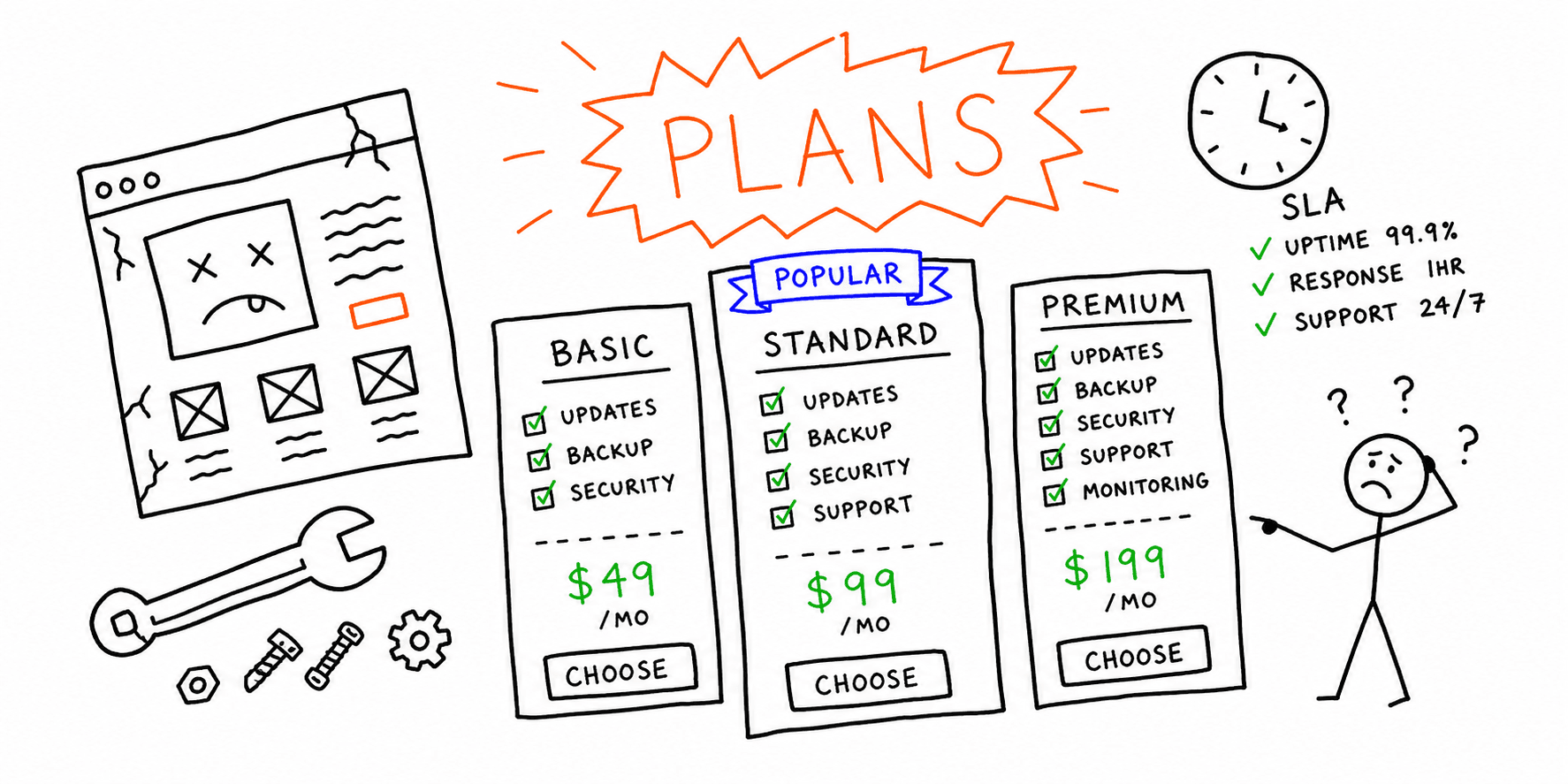

Website Maintenance Services: WordPress Packages, SLAs, and Pricing
Website maintenance services help teams keep sites secure, fast, and conversion-ready after launch. This guide breaks down what services to include, how monthly website maintenance packages should be structured, and how to price plans so margin and delivery stay healthy.
If you are comparing wordpress website maintenance services or broader website support services, use this page to separate routine upkeep from true support obligations and map each one to an SLA.
Need a baseline before you quote? Start with a site health check, then run a technical website audit to estimate monthly effort.
Website maintenance services vs monthly packages
Teams searching for website maintenance services are usually trying to answer two questions:
- What work will actually be done each month?
- What level of responsiveness is guaranteed when something breaks?
Use this framing:
| Model | Best use case | Main buying signal |
|---|---|---|
| One-off maintenance services | Sites with irregular change needs | Flexibility, no retainer commitment |
| Monthly website maintenance packages | Sites that need predictable coverage and SLAs | Fixed scope, fixed response times, reporting |
If your client has ongoing campaigns, frequent content updates, or critical conversion flows, monthly packages usually outperform ad-hoc services on cost and speed.
What website maintenance services should include
Every package should have the same core service blocks, even if response times and hours differ by tier.
| Service block | Minimum standard for monthly plans |
|---|---|
| Security updates | CMS/plugin/theme patching every month + emergency patch policy |
| Backups and recovery | Automated backups + quarterly restore test |
| Uptime + error tracking | Alerting for downtime, 4xx/5xx spikes, and broken forms |
| Performance monitoring | Monthly Core Web Vitals review and optimization queue |
| SEO hygiene | Broken links, redirect chains, indexation anomalies |
| Reporting | 1 monthly report with actions completed, issues found, next priorities |
Website support and maintenance services: what buyers expect
Buyers searching for website support and maintenance services usually compare ongoing accountability, not one-time fixes. Make this clear in your service page and proposal:
- Named owner for each account (not a generic queue)
- Defined support channels and response windows
- Monthly delivery plan tied to business goals
- Clear distinction between maintenance work and project work
- Escalation path for production incidents
For demand generation, pair this page with a practical estimator like Website Maintenance Cost and a workflow article like Website Maintenance Plan.
Website support services vs website maintenance services
Teams often mix these terms, but buyers usually evaluate them differently:
| Query | Buyer intent | What your offer should prove |
|---|---|---|
| website maintenance services | Prevent breakage and performance decline | Preventive scope, recurring cadence, KPI reporting |
| website support services | Resolve incidents quickly when issues happen | Response windows, escalation flow, issue ownership |
| website support and maintenance services | Need both prevention and rapid response | Combined package with clear runbook + SLA matrix |
If your page targets website support services, show exact response commitments by severity and who owns incident triage. Without this, the offer reads like a checklist, not a service.
WordPress website maintenance services: what to include each month
For teams running WordPress, buyers expect more than plugin updates. A strong wordpress website maintenance services package should publish WordPress-specific controls and proof of execution.
| WordPress workstream | Why it matters | Minimum monthly standard | KPI to report |
|---|---|---|---|
| Core, plugin, and theme updates | Reduces security and compatibility risk | Scheduled patch window + rollback plan | % assets updated on time |
| Staging QA before production deploys | Prevents regressions on critical pages | Test checkout/forms/navigation before go-live | Escaped defects after release |
| Backup + restore validation | Backups are useless if restore fails | One restore test per month | Restore success rate + restore time |
| Database and cache hygiene | Keeps admin and page rendering fast | Optimize tables, clear stale transients, tune cache rules | Admin TTFB and cache hit rate |
| Core Web Vitals fixes | Protects conversion and SEO performance | Monthly CWV review and prioritized fixes | LCP/INP/CLS pass rate |
| Security hardening | Limits brute force and exploit impact | WAF/login hardening + vulnerability scan | Blocked attack events + critical issues closed |
Pair this with a Core Web Vitals test, site performance audit, and SEO on-page analysis to document outcomes each month.
If the team needs a WordPress-specific speed playbook, use Improve Website Speed (5 Ways) together with the Website Maintenance Checklist.
Monthly website maintenance package tiers
Use tiering to separate response speed and capacity, not random feature lists.
| Tier | Best for | Included hours | Response SLA | Typical monthly range |
|---|---|---|---|---|
| Essential | brochure sites and low-change pages | 2 to 4 | 2 business days | $150 to $500 |
| Growth | active marketing sites and lead-gen | 5 to 10 | next business day | $500 to $1,500 |
| Performance | ecommerce, SaaS, and high-traffic ops | 10 to 25 | same day for priority | $1,500 to $5,000+ |
If you need a deeper budgeting model, use the ranges in Website Maintenance Cost and map them to your internal hourly rates.
For teams that need a delivery framework first, use Website Maintenance Plan before finalizing tiers.
How to set website maintenance packages pricing
Use this structure for transparent package pricing:
- Base retainer: monitoring, patching, and reporting overhead.
- Included execution hours: fixed hours for routine fixes and improvements.
- Risk multiplier: higher for ecommerce, regulated, or high-revenue sites.
- Overage rate: predefined hourly rate when included time is exceeded.
Formula:
Monthly package price = base retainer + (included hours x blended hourly rate) + risk premium
To defend margin, define what counts as routine maintenance vs project work. Redesigns, migrations, and net-new feature builds should be out of scope.
Scope guardrails to include in every package
- Max number of content edits per month
- Max engineering hours included
- Response and resolution targets by issue severity
- Explicit out-of-scope list (new templates, integrations, redesign work)
- Approval flow for overage work
- Monthly review call cadence
These guardrails reduce churn and protect delivery quality.
Service-level commitments (SLA) to publish on your services page
If you want to rank and convert for website maintenance services, publish explicit SLAs:
- Incident response windows by severity (P0, P1, P2)
- Guaranteed backup frequency and restore testing cadence
- Maximum turnaround for routine change requests
- Monthly reporting date and review cadence
- Escalation path for outages
Many agencies list features, but skip service levels. That creates sales friction and weakens trust.
30-day onboarding checklist for a new maintenance client
Week 1:
- Run a website audit tool report
- Inventory plugins, integrations, and analytics tags
- Confirm backup + restore access
Week 2:
- Patch security issues and close critical technical debt
- Set uptime/error alerts and assign escalation contacts
- Build a maintenance backlog with priority labels
Week 3:
- Execute first optimization batch (speed, UX, SEO hygiene)
- Finalize monthly reporting template and KPI owners
Week 4:
- Deliver first maintenance report
- Review hours consumed vs included capacity
- Adjust package tier if scope mismatch appears
Monthly maintenance report template
| KPI | This month | Last month | Change | Action owner |
|---|---|---|---|---|
| Incidents resolved | ||||
| Avg response time | ||||
| Core Web Vitals pass rate | ||||
| Critical SEO issues closed | ||||
| Uptime % | ||||
| Backlog carryover items |
Buyer checklist for choosing website maintenance services
Before signing a provider or plan, confirm:
- Scope includes technical SEO hygiene, not just plugin updates
- SLA terms are written and tied to issue severity
- Reporting includes outcomes, not only completed tasks
- Overage rules are defined in advance
- Security monitoring and backup restore testing are included
For a faster due-diligence pass, combine this with a site performance audit, SEO on-page analysis, and website checker.
Related resources
- Website maintenance plan
- Website maintenance checklist
- Website maintenance cost
- Website audit software
Final thoughts
The best monthly website maintenance packages are boring on purpose: clear scope, consistent cadence, and measurable outcomes. If you package around response time, included capacity, WordPress-specific controls, and risk, you get predictable delivery and healthier client retention.